
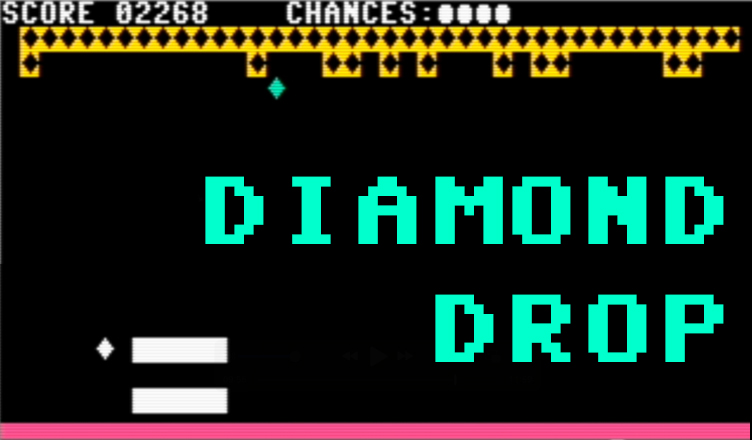
Title – Diamond Drop
System – Commodore 64
Authors – Matt Giwer
Publication – COMPUTE! Issue 40, September 1983
Page Scans – 1 2 3 4
Preserved by – eboy71
Recommended Emulator – VICE
/Diamond%20Drop%20-%20Screenshot%201.png) .
. /Diamond%20Drop%20-%20Screenshot%202.png)
Loading the Game –
- Mount the disk image (Compute 040 – Diamond Drop.d64) in your emulator. In VICE, this is done by selecting File → Attach Disk Image
- Load the app by typing LOAD”DIAMOND DROP”,8,1
- Once loaded, type RUN to start
Game Instructions –
- The objective of Diamond Drop is to catch all of the objects dropping from the top of the screen to get the highest score you can.
- When one hits the ground, you lose a life; when you lose 5 lives, your game is over.
- Moving the paddles is done with the following keys:
- L – left
- ; – right
Article Text
Catch the falling diamonds – if you can. This fast-action game is easy to play and uses very little memory. Originally written for the Atari (with paddle), other versions are included for the TI-99/4A (with Extended BASIC) and the VIC and 64.
Note: the following article text was written for the Atari version. It’s still interesting, though. 🙂
“Diamond Drop” is a game that requires good judgment and quick reflexes. It’s fast, easy to play, and will fit into even the smallest Atari. The game uses both player/missile graphics and the Atari’s fast string handling. The game plays quickly in BASIC with no machine language routines and uses less than 7K of RAM.
Four rows of diamonds will appear at the top of the screen. At the bottom, you’ll see five catching trays, which are controlled by your paddle. As the diamonds drop, position your trays to catch them. Each diamond is worth ten points. If you miss, you lose one tray. If you complete one row, you get a lOO-point bonus. Finish all four rows and you get a 250-point bonus. When you have lost all of your trays, the high score is recorded on the left of the screen, and you start again.
You won’t be able to anticipate a dropping pattern because the subroutine at line 20000 generates a random sequence of two-digit numbers that will not repeat. Each number appears only once within the string.
The routine starts off with AA$ (line 20012), which contains the numbers 05 through 34. (These are the column numbers for the POSITION instructions.) The G LOOP then picks two of these pairs of numbers randomly and exchanges their positions within AA$. Thirty exchanges within this string of thirty pairs of numbers work well for this game.
Editor’s Notes:
- Matt Giwer is credited for this game, as well as another COMPUTE! game called Blockhead.
- This is a terrific little arcade game! It’s kind of like an opposite version of Breakout.


/1983-09%20Diamond%20Drop%20-%20COMPUTE%20-%20p76.jpg)
/1983-09%20Diamond%20Drop%20-%20COMPUTE%20-%20p84.jpg)
/1983-09%20Diamond%20Drop%20-%20COMPUTE%20-%20p86.jpg)
/1983-09%20Diamond%20Drop%20-%20COMPUTE%20-%20p88.jpg)