
Title – Blockhead
System – Commodore 64
Author – Matt Giwer
Publication – COMPUTE! Issue 037, June 1983
Page Scans – 1 2 3 4 5
Preserved by – eboy71
Recommended Emulator – VICE
Loading the Game –
- Mount the disk image (Compute 039 – Blockhead.d64) in your emulator. In VICE, this is done by selecting File → Attach Disk Image
- Load the app by typing LOAD”BLOCKHEAD”,8,1
- Once loaded, type RUN to start
Game Instructions –
- Blockhead requires the use of paddles. To set these up in VICE:
- Before loading: Preferences → Settings → Input Devices → Control Port
- Set Control Port 1 and Port 2 to “Paddles”
- When the game loads: Preferences → Mouse Grab
- Toggle on to play; toggle off when finished
- This will allow you to use your mouse as the paddle.
- Before loading: Preferences → Settings → Input Devices → Control Port
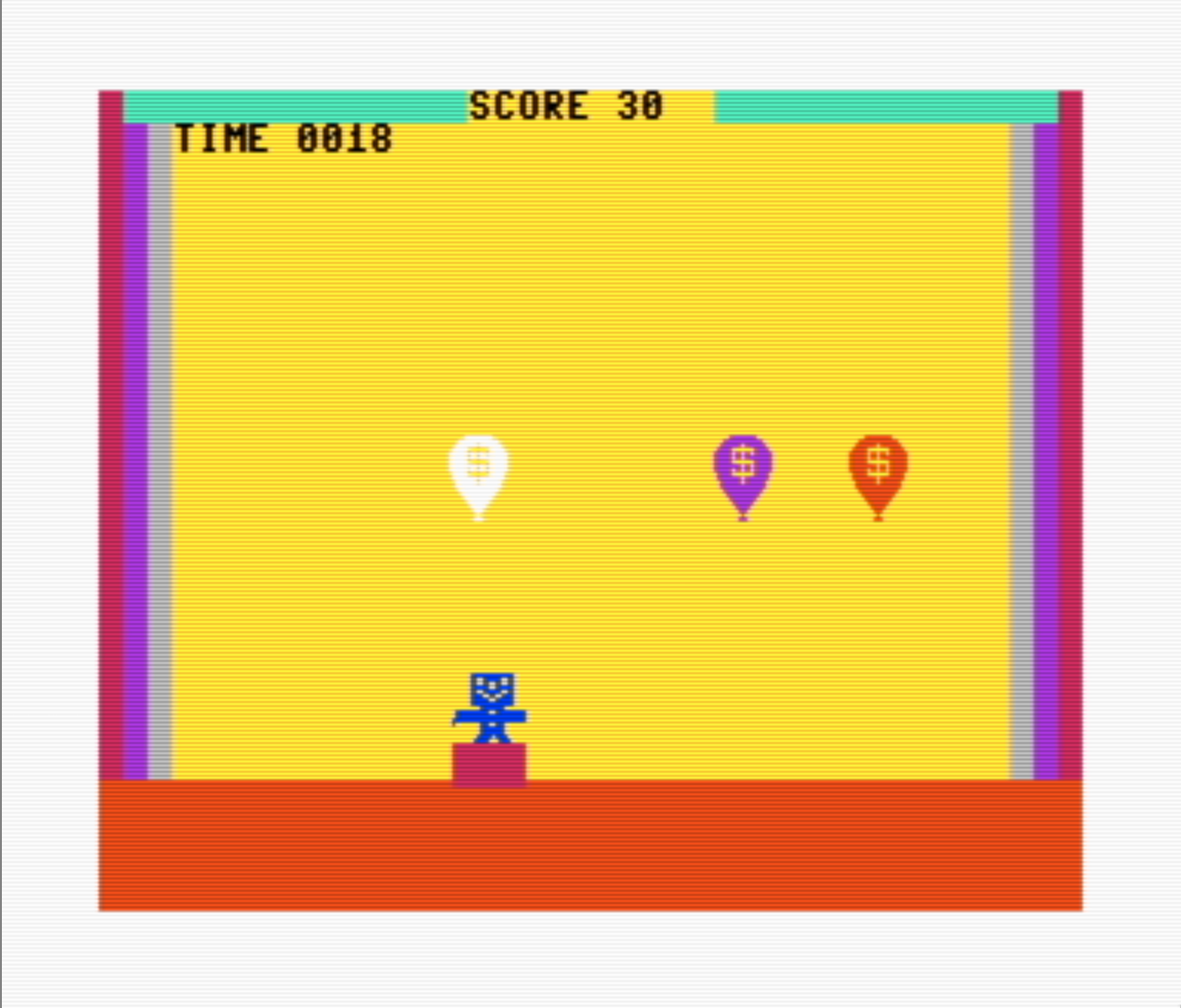
- In the game, you control a character named Blockhead. The goal is to pop as many balloons as possible before the timer reaches 200.
- Pressing the paddle button (mouse click) will launch Blockhead towards the line of moving balloons. He will then fall somewhat erratically and you will need to catch him in order to claim the points. Points are added to your score after he is caught.
- A successful balloon pop is worth 10 points, and you can also get 10 points by getting close to a balloon, although this doesn’t happen all the time.
- If you miss Blockhead, you will lose 15 points and need to launch him from “under” the screen with the button
- The game ends once the timer hits 200.
Article Text
The blockhead moves vertically, bouncing as he goes, and tries to pop the floating balloons. You must catch him as he comes down, but his wildly erratic movements make that very difficult. Versions for 64 and Atari – requires paddles.
Editor’s Note:
- Matt Giwer is credited for this game, as well as another COMPUTE! game called Diamond Drop.
- It also appeared in the book, COMPUTE!’s First Book of Commodore 64 Games, 1983
- This game was originally written for Atari 8-bit systems and then ported to the 64 by Gregg Peele. There appear to be significant differences between the versions. They are basically different games entirely.
- In the Atari version, you get 5 men and as the levels clear, they get harder and he comes down more erratically. In the 64 version, you have unlimited lives, and the goal is to get as many points as possible before the 200 second timer runs out. Missing Blockhead on the way down doesn’t cost a life, and instead deducts 15 points from the score.
- In addition, many balloons are displayed in the Atari version, and the goal is to clear the boards. In the 64 version, there are 6 balloons that float across the screen. Once they are cleared, they appear again higher up the board.
- The code in the magazine is flawed. There was a CAPUTE! column in issue 43 that corrected some of the typos, but not all, meaning that as published, this game would not work correctly. However, a correct version was eventually published in COMPUTE!’s First Book of Commodore 64 Games, later in 1983.
- By default, the game is set to use Atari paddles. If you are using Commodore 64 paddles, 2 lines of code need to be changed: 1070 and 1080. These lines have been changed for this version. If these changes are not made, the game will periodically crash with an ILLEGAL QUANTITY ERROR.
- However, this change for the paddles will conflict with a checksum routine that was added in the listing in First Book of Commodore 64 Games (it was not in the original COMPUTE! article.) Specifically, line 1051 calculates the checksum for the data statements and throws an error if there is a problem. Changing lines 1070 and 1080 result in the checksum not working. To make the game work, I simply added a REM statement before the line.


/1983-08%20Blockhead%20-%20Compute%20039%20-%20p100.png)
/1983-08%20Blockhead%20-%20Compute%20039%20-%20p102.png)
/1983-08%20Blockhead%20-%20Compute%20039%20-%20p106.png)
/1983-08%20Blockhead%20-%20Compute%20039%20-%20p107.png)
/1983-08%20Blockhead%20-%20Compute%20039%20-%20p108.png)