
Title – Blackbox
System – Commodore 64
Authors – Jeff Kenton
Publication – More Basic Computer Games, 1979
Page Scans – 1 2
Preserved by – eboy71
Recommended Emulator – VICE
/Blackbox-Screenshot.png) . .
. .
Loading the Game –
- Mount the disk image (MBCG – Blackbox.d64) in your emulator. In VICE, this is done by selecting File → Attach Disk Image
- Load the app by typing LOAD”BLACKBOX”,8
- Once loaded, type RUN to start
Article Text & Instructions
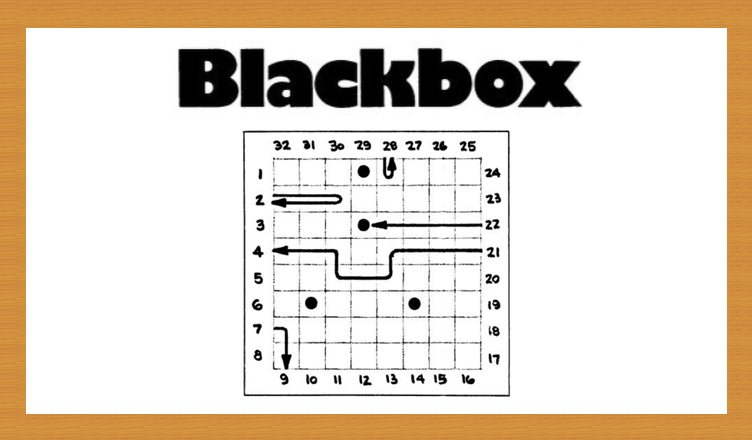
Black Box is a computerized version of the game that appeared in the August 1977 issue of Games and Puzzles. The Black Box is an 8-by-8 square in which several atoms are hidden. The object of the game is to discover the positions of the atoms by projecting rays at them from the sides of the box and noticing how these rays are deflected, reflected, or absorbed. Rays enter the box across one of the four edges and travel horizontally or vertically. The entry points are numbered from 1 to 32, counterclockwise, starting at the top of the left edge.
To play the game you first specify how many atoms to place in the Black Box. Then you type in the point at which you send the ray into the box, and you are told whether the ray was absorbed or where it emerged. Type a zero to end the game and print the board. The path of the ray is governed by the following rules:
- Rays that strike an atom directly are absorbed.
- Rays that come within one square of an atom in a diagonal direction (so that they would pass next to the atom if they continued) are deflected by 90 degrees.
- Rays aimed between two atoms one square apart are reflected.
- Rays that enter on either side of an atom on the edge of the box are reflected.
- Rays otherwise travel in straight lines.
The game is pretty interesting with four or five atoms, but can get out of hand with too many more. Occasionally, an atom can be masked by others. This doesn’t occur often, but sometimes the position is truly ambiguous (more often, there is only one place the atom can be.) For competitive play, score one point for reflections and absorptions, two for rays which emerge from the box, and five points for each atom guessed correctly.
This program and description were written by Jeff Kenton. A previous version appeared in Creative Computing, May/Jun 1978.
Editor’s Note:
- This game was published in 1979, years before computers became household items. Graphics were rudimentary, or more likely, non-existent. The book itself even indicates that screens are optional, as some people just used printers as output. However, the game itself is actually fairly complicated, especially with 3 or more atoms; there just isn’t a graphical interface to show you what’s going on. As such, it feels like this is best played with a pencil and paper so you can keep track of what is going on, note the paths of the rays, and indicate where the atoms are. I have made a simple grid that you can print to play on and it’s included in the ZIP file with the ROM.
- This game is written in “generic” Microsoft BASIC, and as such, doesn’t contain any colors, sounds, or C64-specific commands. I added a “Clear Screen” command as the very first line, just to start the game on a blank page. I also made a couple of minor text changes so that it displays better on the C64’s 40-column display.


/More%20Basic%20Computer%20Games%20-%20p10.png)
/More%20Basic%20Computer%20Games%20-%20p11.png)