

Welcome to the fifth year of the Gaming Alexandria Video Game Notables! We’re excited to bring you another round of our community-voted Hall of Fame for some of the most significant games (and more) of all time!
With this year, we reach 42 entrants into the Notables – a wonderful number if I do say so. Our special awards grow as well: 4 excellent influences on video games, 3 people who have helped shape the medium, and this year we’ve added our Ecosystem award to highlight the support structures of the gaming world!
As always, if you need further information on what this is and the process, you can always go back to the posts for prior years: 2022, 2023, 2024, 2025. Every year we add six (6) new games via a Ranked Choice Voting system, as well as a single entrant for our special categories. This was narrowed down from a pool of 56 games (which you can view a near-complete preview reel here), 7 general influences, 8 people, and 7 ecosystems.
Competition was fierce this year! Thanks as always to our voting board, which this year consisted of 14 people (including myself). If you want to be involved in shaping the future of the Notables, the only requirement is to join the Gaming Alexandria Discord server (which, come on, you should already be there).
Now it’s time to show who won this whole thing! If you’d like to join in on the surprise late, our livestream where we revealed these entrants was recorded – along with all the color commentary you could ever want. Welcome the Video Game Notables, class of 2026!
2025 Inductees
Notable Influence on Video Games
Horror transformed in the reaches of an unforgiving frontier. Alien measured optimism over a
space-faring future with existential dread – through the lens of the New Hollywood movement. The grungy aesthetic, isolated circumstances, and cynical worldview made an immediate impact on the newly developing world of video games. From direct homages such as Metroid or Project Firestart to subtler shades of System Shock and Subnautica, the world and story of Alien has maintained its hold on the psyches of video game creators. How many games feature unethical megacorporations, H. R. Giger-esque designs, or environmental details directly inspired by the classic film? Enduring in its frightening power and iconic imagery, the horror game genre – and many others besides – owe more than a little debt to Alien.
Notable Gaming Ecosystem
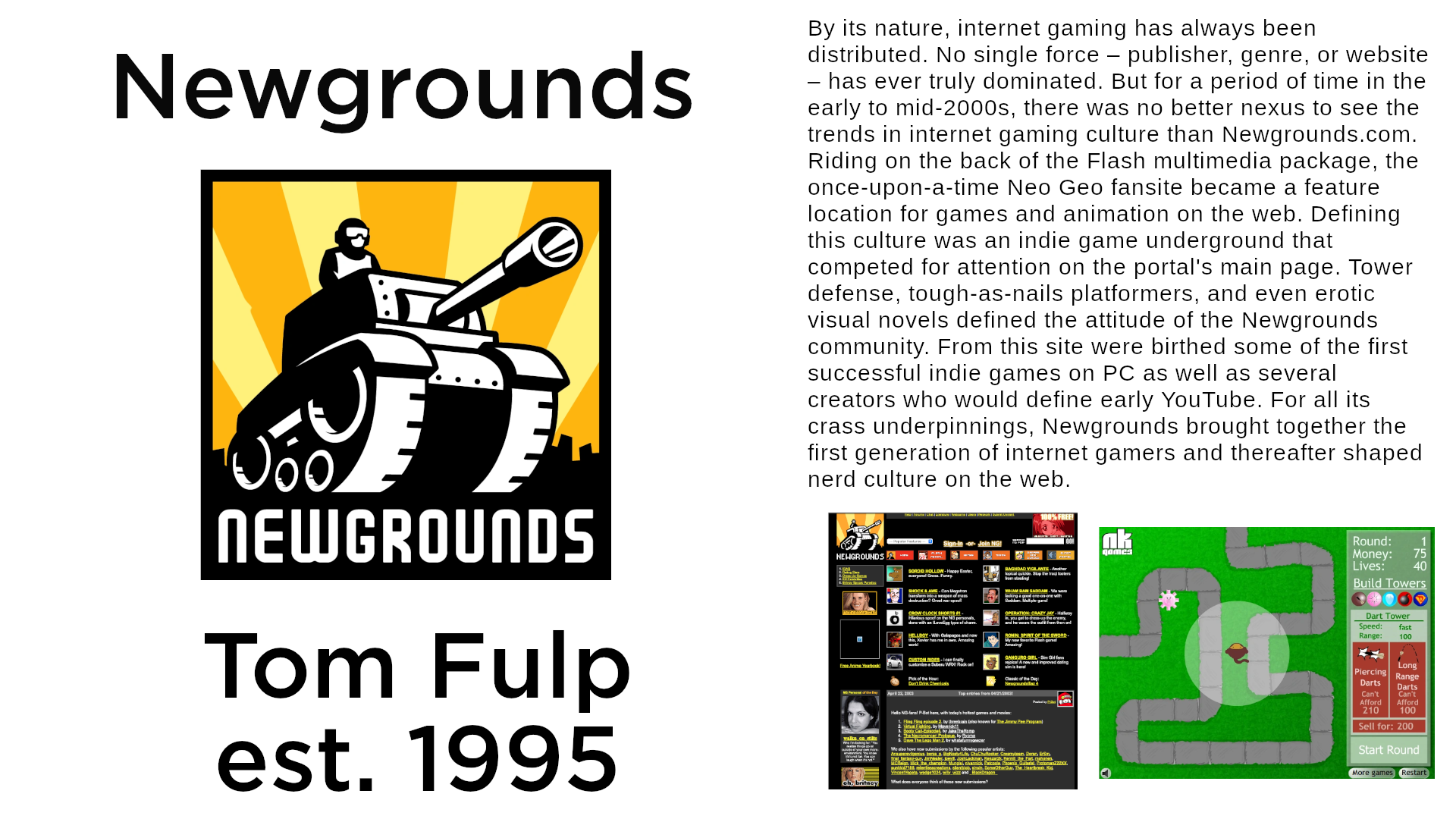
By its nature, internet gaming has always been distributed. No single force – publisher, genre, or website – has ever truly dominated. But for a period of time in the early to mid-2000s, there was no better nexus to see the trends in internet gaming culture than Newgrounds.com. Riding on the back of the Flash multimedia package, the once-upon-a-time Neo Geo fansite became a feature location for games and animation on the web. Defining this culture was an indie game underground that competed for attention on the portal’s main page. Tower defense, tough-as-nails platformers, and even erotic visual novels defined the attitude of the Newgrounds community. From this site were birthed some of the first successful indie games on PC as well as several creators who would define early YouTube. For all its crass underpinnings, Newgrounds brought together the first generation of internet gamers and thereafter shaped nerd culture on the web.
Video Game Notables
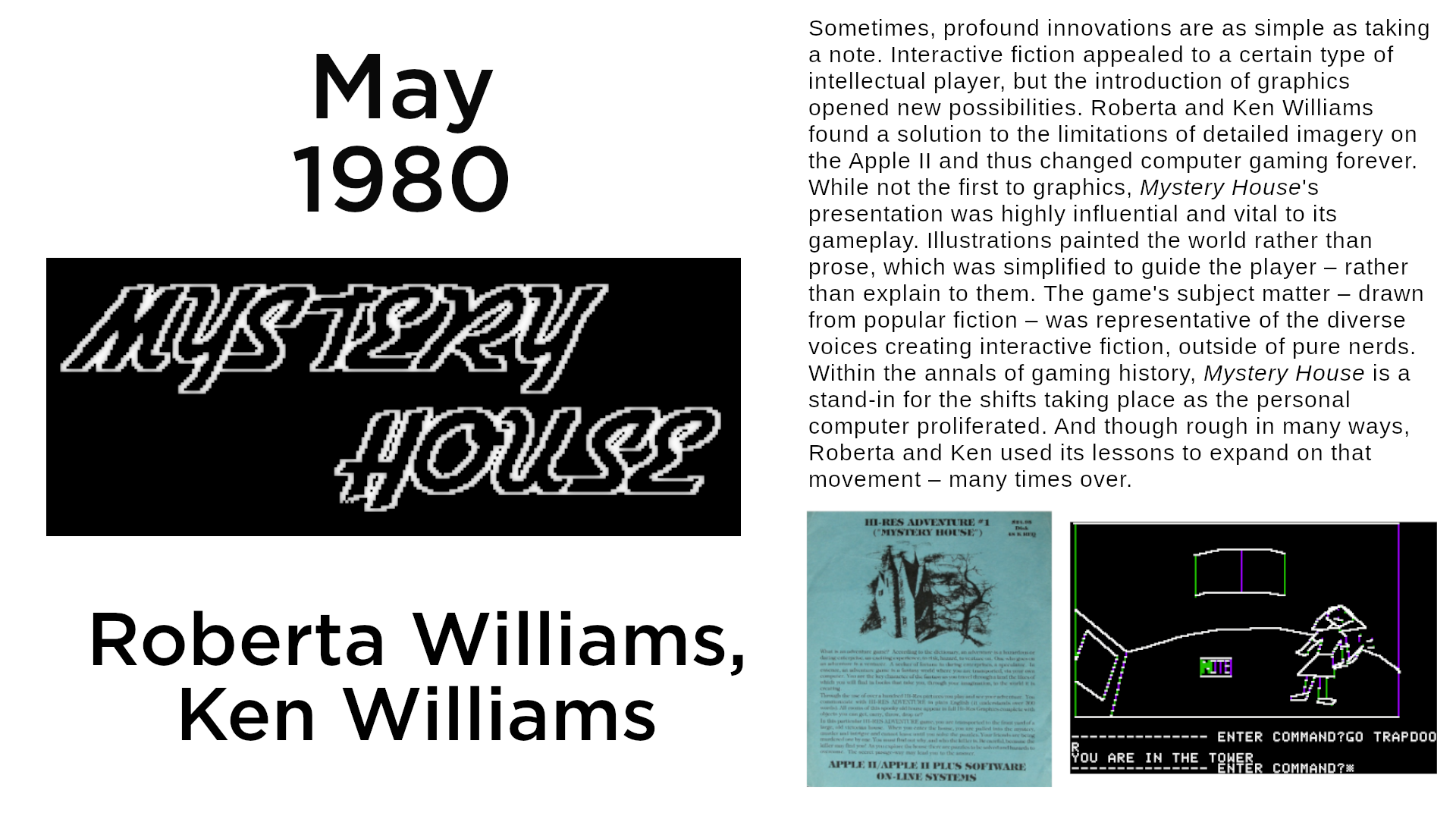
Sometimes, profound innovations are as simple as taking a note. Interactive fiction appealed to a certain type of intellectual player, but the introduction of graphics opened new possibilities. Roberta and Ken Williams found a solution to the limitations of detailed imagery on the Apple II and thus changed computer gaming forever. While not the first to graphics, Mystery House‘s presentation was highly influential and vital to its gameplay. Illustrations painted the world rather than prose, which was simplified to guide the player – rather than explain to them. The game’s subject matter – drawn from popular fiction – was representative of the diverse voices creating interactive fiction, outside of pure nerds. Within the annals of gaming history, Mystery House is a stand-in for the shifts taking place as the personal computer proliferated. And though rough in many ways, Roberta and Ken used its lessons to expand on that movement – many times over.
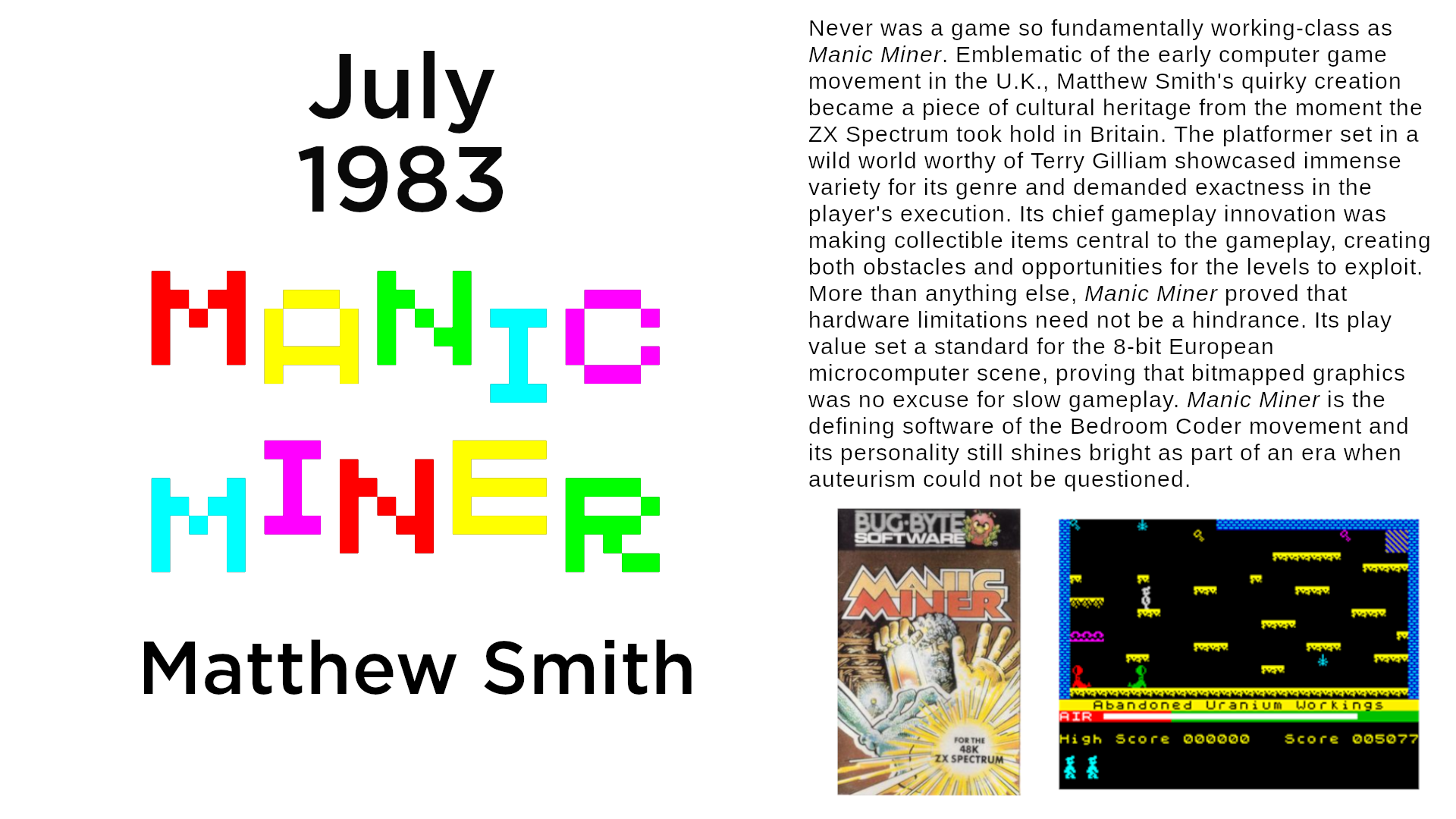
Never was a game so fundamentally working-class as Manic Miner. Emblematic of the early computer game movement in the U.K., Matthew Smith’s quirky creation became a piece of cultural heritage from the moment the ZX Spectrum took hold in Britain. The platformer set in a wild world worthy of Terry Gilliam showcased immense variety for its genre and demanded exactness in the player’s execution. Its chief gameplay innovation was making collectible items central to the gameplay, creating both obstacles and opportunities for the levels to exploit. More than anything else, Manic Miner proved that hardware limitations need not be a hindrance. Its play value set a standard for the 8-bit European microcomputer scene, proving that bitmapped graphics was no excuse for slow gameplay. Manic Miner is the defining software of the Bedroom Coder movement and its personality still shines bright as part of an era when auteurism could not be questioned.
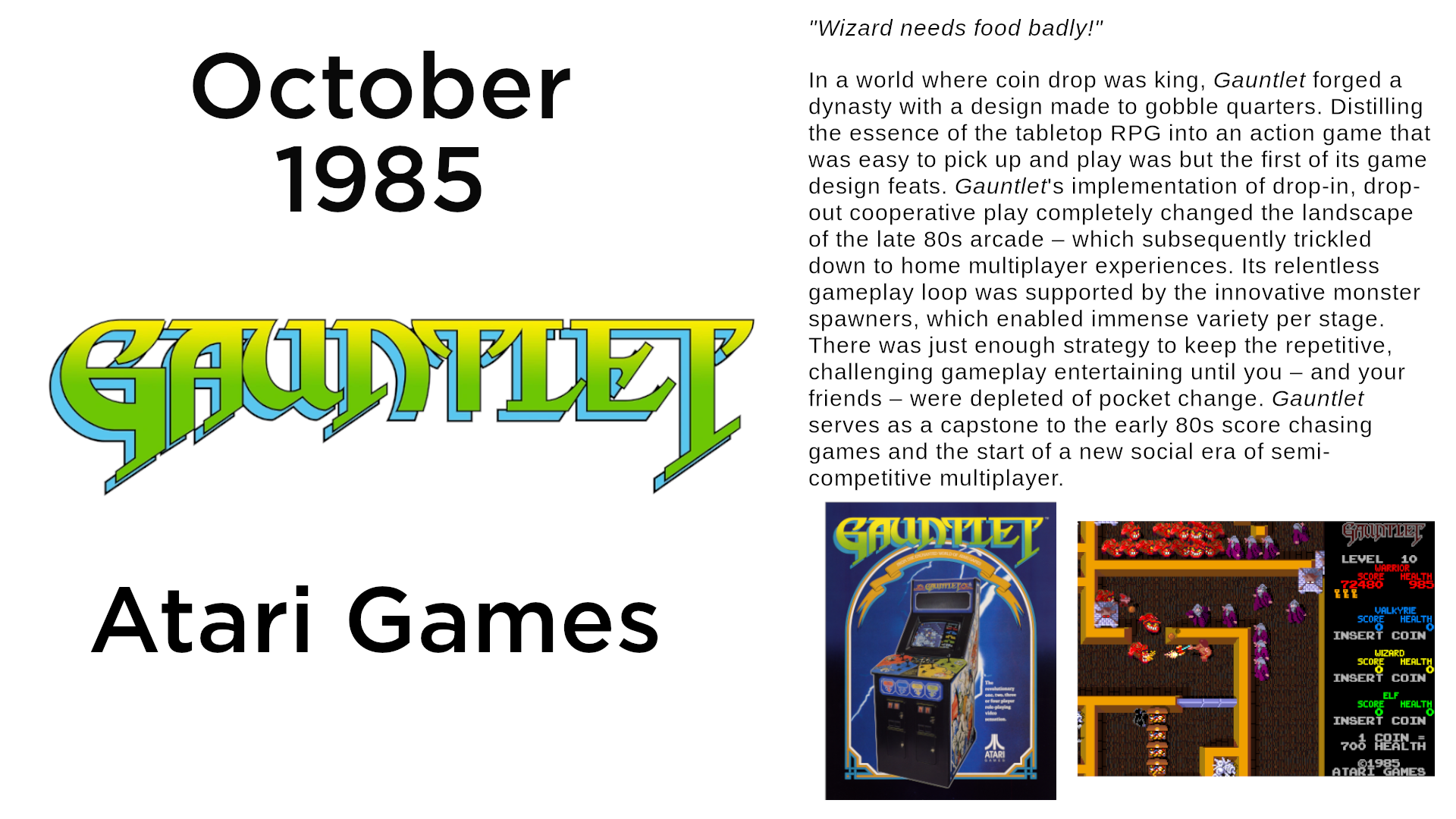
“Wizard needs food badly!”
In a world where coin drop was king, Gauntlet forged a dynasty with a design made to gobble quarters. Distilling the essence of the tabletop RPG into an action game that was easy to pick up and play was but the first of its game design feats. Gauntlet‘s implementation of drop-in, drop-out cooperative play completely changed the landscape of the late 80s arcade – which subsequently trickled down to home multiplayer experiences. Its relentless gameplay loop was supported by the innovative monster spawners, which enabled immense variety per stage. There was just enough strategy to keep the repetitive, challenging gameplay entertaining until you – and your friends – were depleted of pocket change. Gauntlet serves as a capstone to the early 80s score chasing games and the start of a new social era of semi-competitive multiplayer.
“Remember, don’t shoot food!”
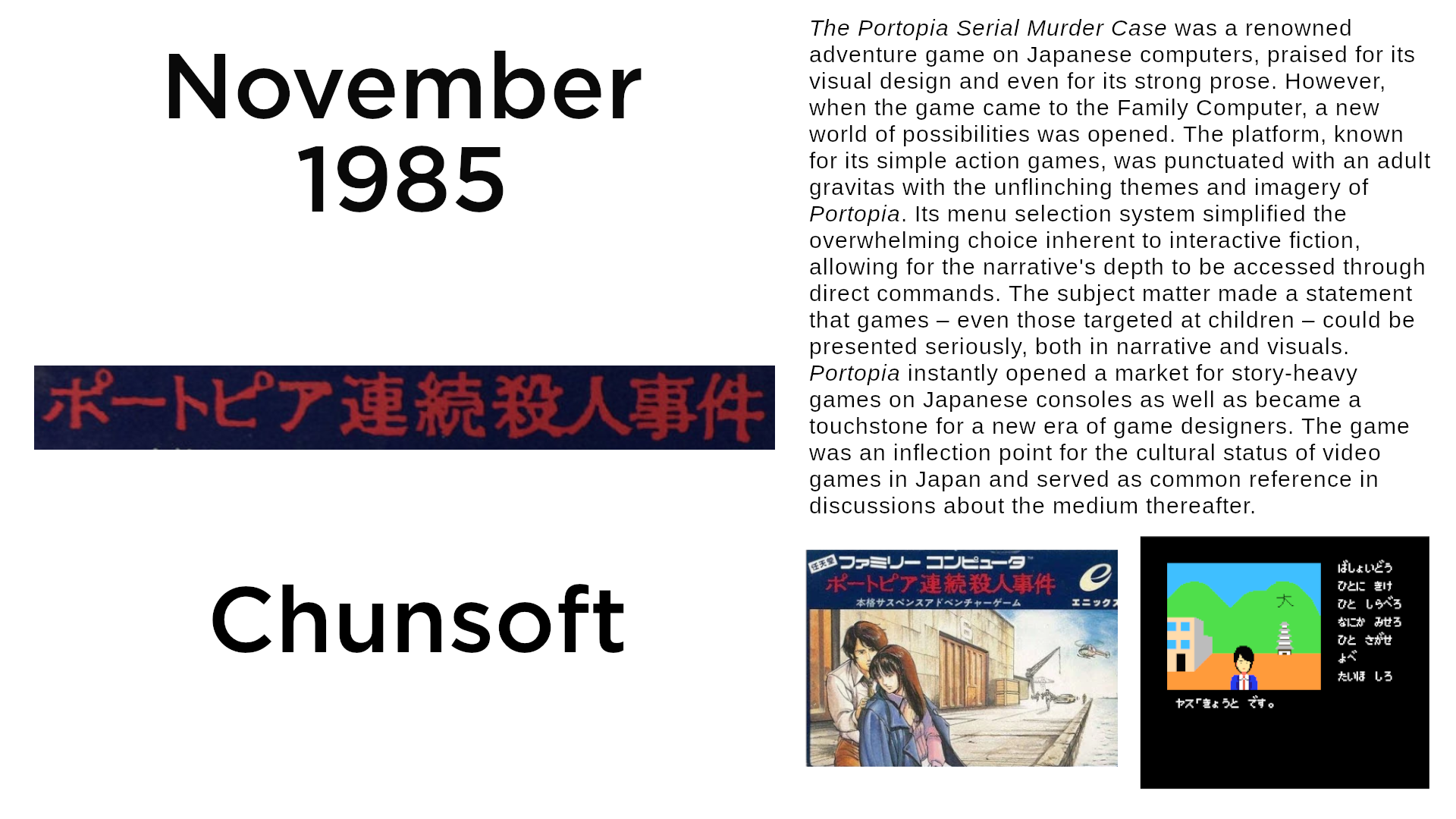
The Portopia Serial Murder Case was a renowned adventure game on Japanese computers, praised for its visual design and even for its strong prose. However, when the game came to the Family Computer, a new world of possibilities was opened. The platform, known for its simple action games, was punctuated with an adult gravitas with the unflinching themes and imagery of Portopia. Its menu selection system simplified the overwhelming choice inherent to interactive fiction, allowing for the narrative’s depth to be accessed through direct commands. The subject matter made a statement that games – even those targeted at children – could be presented seriously, both in narrative and visuals. Portopia instantly opened a market for story-heavy games on Japanese consoles as well as became a touchstone for a new era of game designers. The game was an inflection point for the cultural status of video games in Japan and served as common reference in discussions about the medium thereafter.
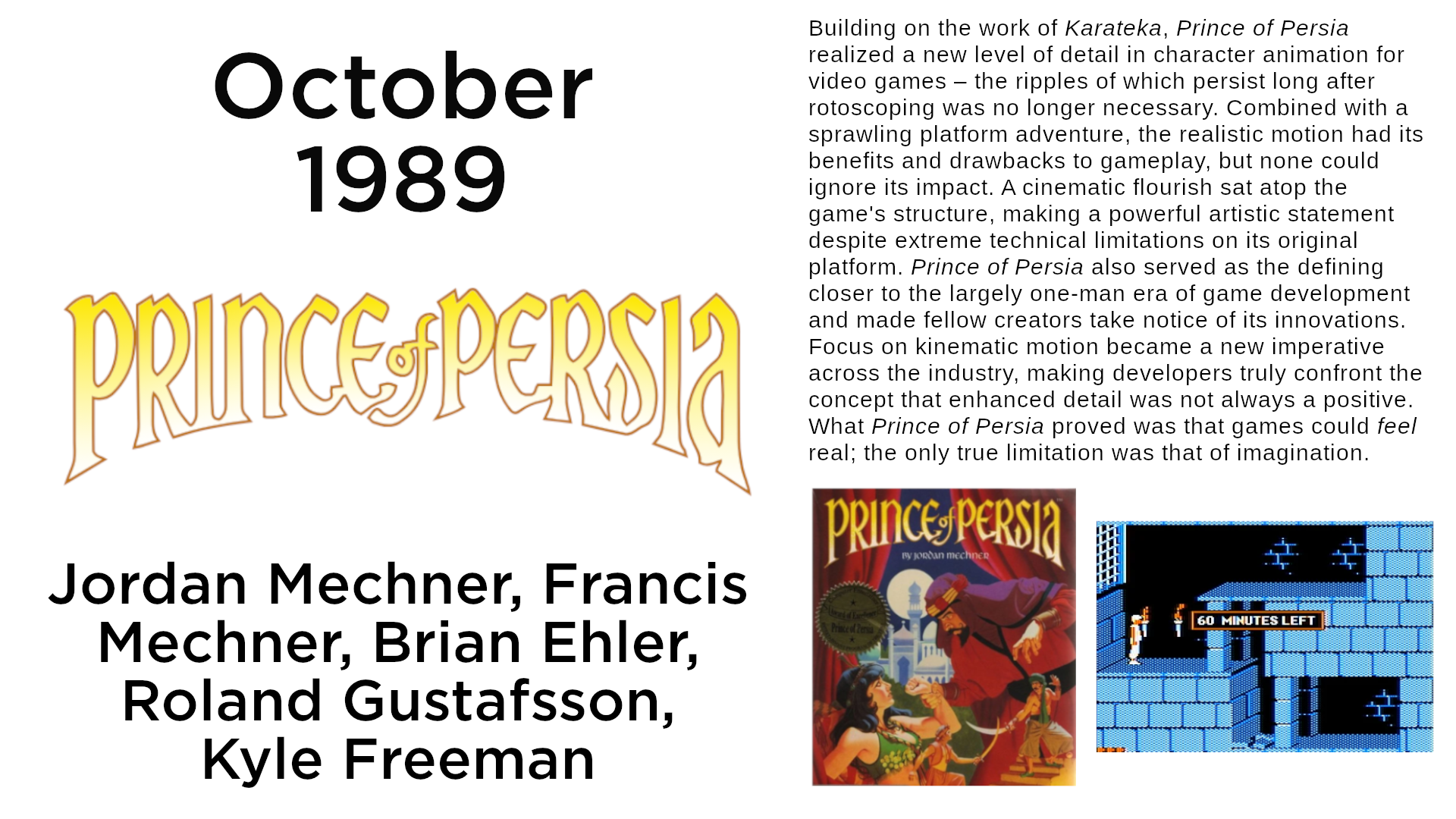
Building on the work of Karateka, Prince of Persia realized a new level of detail in character animation for video games – the ripples of which persist long after rotoscoping was no longer necessary. Combined with a sprawling platform adventure, the realistic motion had its benefits and drawbacks to gameplay, but none could ignore its impact. A cinematic flourish sat atop the game’s structure, making a powerful artistic statement despite extreme technical limitations on its original platform. Prince of Persia also served as the defining closer to the largely one-man era of game development and made fellow creators take notice of its innovations. Focus on kinematic motion became a new imperative across the industry, making developers truly confront the concept that enhanced detail was not always a positive. What Prince of Persia proved was that games could feel real; the only true limitation was that of imagination.
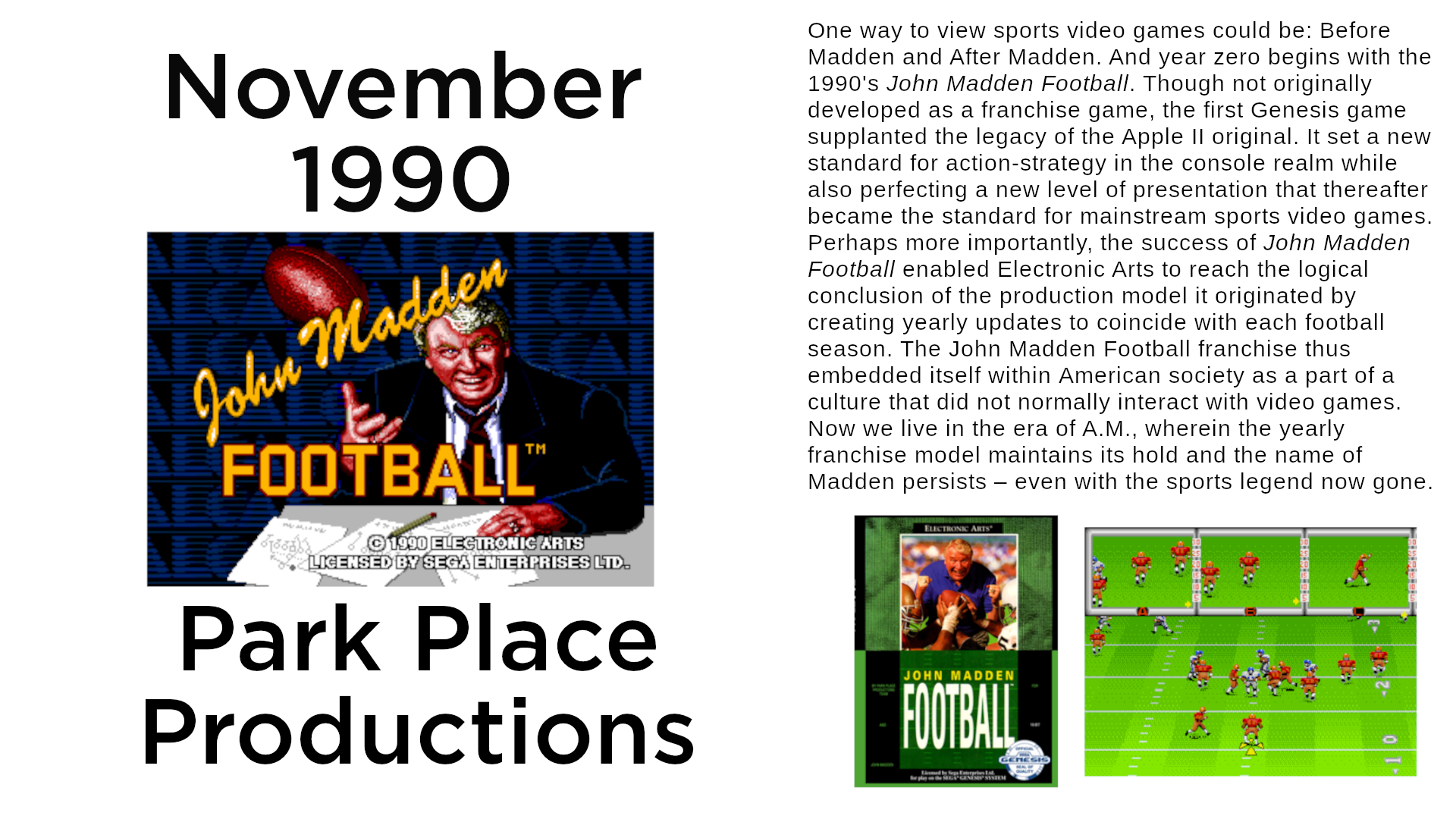
One way to view sports video games could be: Before Madden and After Madden. And year zero begins with the 1990’s John Madden Football. Though not originally developed as a franchise game, the first Genesis game supplanted the legacy of the Apple II original. It set a new standard for action-strategy in the console realm while also perfecting a new level of presentation that thereafter became the standard for mainstream sports video games. Perhaps more importantly, the success of John Madden Football enabled Electronic Arts to reach the logical conclusion of the production model it originated by creating yearly updates to coincide with each football season. The John Madden Football franchise thus embedded itself within American society as a part of a culture that did not normally interact with video games. Now we live in the era of A.M., wherein the yearly franchise model maintains its hold and the name of Madden persists – even with the sports legend now gone.
Notable Individual in Video Games
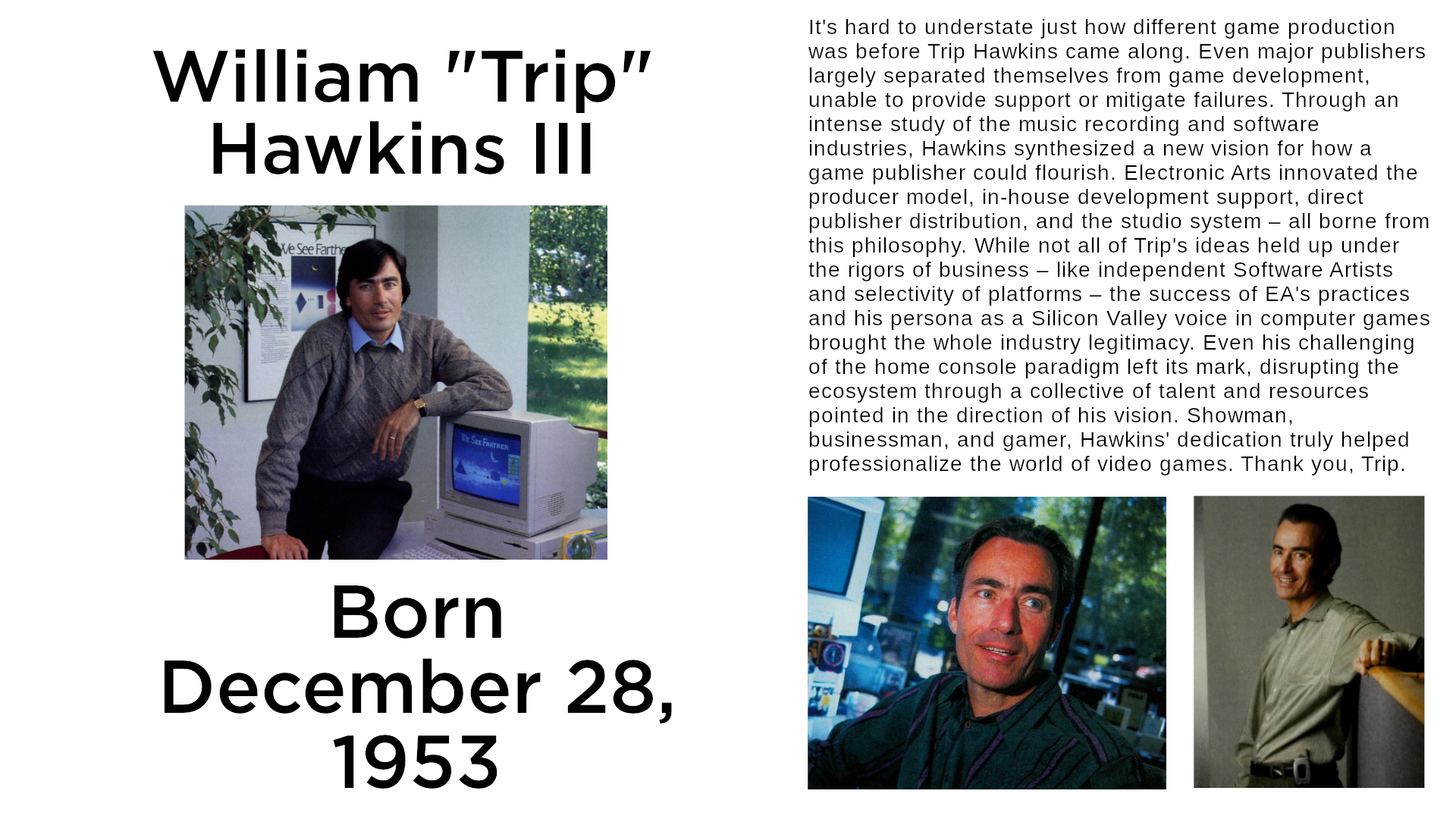
It’s hard to understate just how different game production was before Trip Hawkins came along. Even major publishers largely separated themselves from game development, unable to provide support or mitigate failures. Through an intense study of the music recording and software industries, Hawkins synthesized a new vision for how a game publisher could flourish. Electronic Arts innovated the producer model, in-house development support, direct publisher distribution, and the studio system – all borne from this philosophy. While not all of Trip’s ideas held up under the rigors of business – like independent Software Artists and selectivity of platforms – the success of EA’s practices and his persona as a Silicon Valley voice in computer games brought the whole industry legitimacy. Even his challenging of the home console paradigm left its mark, disrupting the ecosystem through a collective of talent and resources pointed in the direction of his vision. Showman, businessman, and gamer, Hawkins’ dedication truly helped professionalize the world of video games. Thank you, Trip.
This year was a contentious one for some selections – in a positive way! It’s great to see the discourse developing as we bring in new people and evolve the conversation. We’re looking forward to seeing you all next year!