This article is part of a new series on Gaming Alexandria called Origin of Game, stories of how famous game companies came to be! These tales written by staff and guest authors draw on research gathered over the years and give a glimpse into the people who defined video game history. We hope these articles will stoke your desire to learn more about the developers and publishers who have made our world fun!
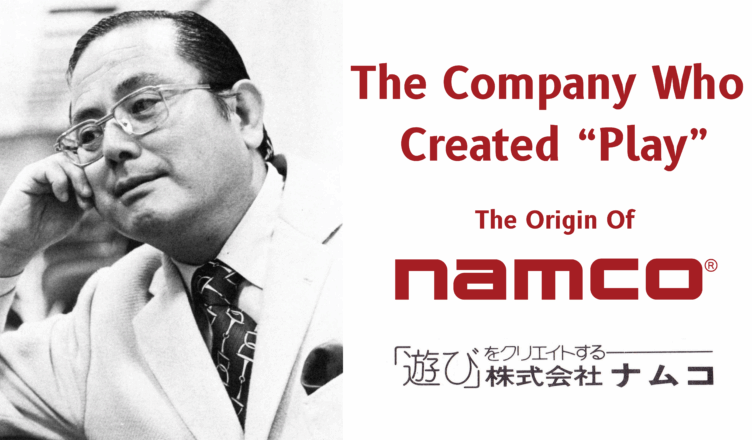
Masaya Nakamura knew when to rebrand. When he founded Nakamura Seisakusho in 1955, their ambition to provide fun for Japanese rooftop amusement parks was represented by the slogan “From Rocking Horses to Monorails.” But during Japan’s economic growth in the mid-60s, they moved towards the abstract – believing they were “Creating Children’s Dreams.” Realizing that globalization was a step towards prosperity in the 70s, the company renamed themselves “Namco”, and adopted a succinct slogan that encapsulated the products they made:「遊び」をクリエイトする (translated as Creating “Play”). Why was Namco so obsessed with fun and dreams and what made “play” so special that it stuck with them for the rest of their days?
Namco’s story naturally begins with its founder, Masaya Nakamura. Born on December 24, 1925 in Izumicho, Kanda Ward (today Chiyoda Ward) in Tokyo, he was one of six children raised by two parents. The Nakamura family got by through a gunsmithing business that Masaya’s grandfather passed down to Ryutaro, Masaya’s father. They primarily dealt with air guns – non-lethal weapons that fired pellets for hunting and target practice. In addition to repair work, Ryutaro operated shooting galleries utilizing these air guns, plus sold and operated amusement machines in the early 30s.
Masaya as a young boy was tasked with repairing guns and delivering newspapers to help with the finances. But his true desire was to become a naval officer. As he grew older, so did his ambition to apply to a naval academy. But this dream was relinquished due to his nearsightedness; he wore glasses for the rest of his life. What didn’t subside was his admiration for the sea and naval officers. After calculating his chances of getting accepted, he entered the shipbuilding department of National Yokohama Technical College (today Yokohama National University) in 1944. He successfully graduated in 1948. However, the aftermath of World War II rendered his chances of finding any shipbuilding work impossible. Masaya consequentially rejoined his father at the gunsmithing business.
Soon after, Masaya and Ryutaro relocated the business into the Takashimaya Department Store in Nihonbashi, Tokyo. The two sold air guns, goods made out of iron like cooking pots, and even shoes. In 1952, Masaya established a branch of the business at the Matsuya Department Store in Ginza, Tokyo. Serving as its manager, Masaya began pivoting towards Western management practices.
Ryutaro and he often disagreed about their repair business. Once Japan’s sovereignty was returned by the occupying forces, the Nakamura business started experiencing hardships due to a commodity tax on purchased goods and new regulations on firearms. Failing to resolve arguments with his father and seeing the decline of the business, Masaya decided to go independent – to not feel like he was betraying his father.
While Masaya contemplated his next move, he recalled a simpler time in his youth. More specifically, an amusement park located on a department store rooftop that he frequented. The park and its creator would not only play a pivotal role in his life, but be deemed as reference points for the development of the Japanese amusement industry.
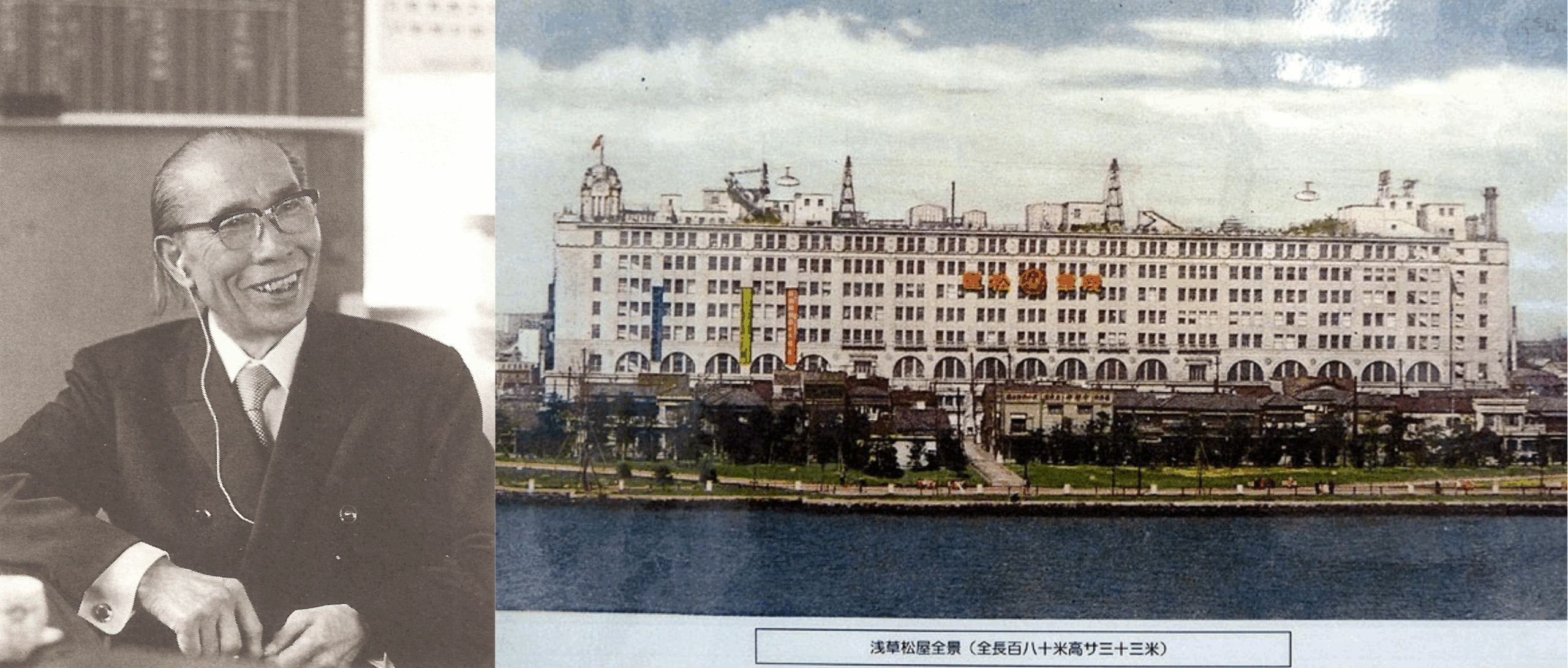
Born in January 1899 in Gifu Prefecture, Kaichi Endo was one of the earliest domestic producers of amusement machines in Japan. Endo gained notoriety in the 1920s for his candy vending machines and automatic rocking horses. Around 1930, he was approached by the Matsuya department store company with a unique proposition. They were getting ready to open a new location in Asakusa, Tokyo, and they wanted to have an amusement park occupy the 7th floor (rooftop) of the facility. This concept was entirely new. Endo’s directive was to create a park that encouraged physical activity, one which he would also supply the necessary machines to.
After months of development, “Sports Land” opened atop Matusya Asakusa in November 1931. Sports Land hosted physical games such as strength testers and mechanical horse races using handles. There also were two aerial gondolas installed on a ropeway. Over time, these machines were replaced with more family-friendly offerings such as kiddie rides or miniature cars and trains. Taking notice of this new direction, department stores across the country opened up rooftop amusement parks modeled after Sports Land. Endo’s work left a lasting impact on amusement industry entrepreneurs, including a young boy who used to visit his park regularly.
Around the time Matsuya Asakusa opened, the Nakamura family resided within close proximity of the store. A young Masaya visited Sports Land while clutching onto the coins his parents gave him. His favorite attraction was the miniature car; he would ride around the facility and seize the moment. Much later, thanks to Ryutaro’s shooting gallery work, Masaya delivered air guns to Endo’s residence in Tokyo. These experiences circled back around at the crucial point in Masaya’s career in 1955.
After going independent, Masaya had no idea what type of business he should start. But what struck him was seeing children playing tag in ruins and back allies of Japan. Amusement facilities were in varying states of destruction due to the war, so children had fewer places to go. Seeing these children reminded him of the fun he used to have at Sports Land and later meeting Kaichi Endo. He had an epiphany; one that served as the birth of his new career. As he recalled during an interview, “I wanted to build a facility, such as one on a department store rooftop, where these children can play happily and safely.”

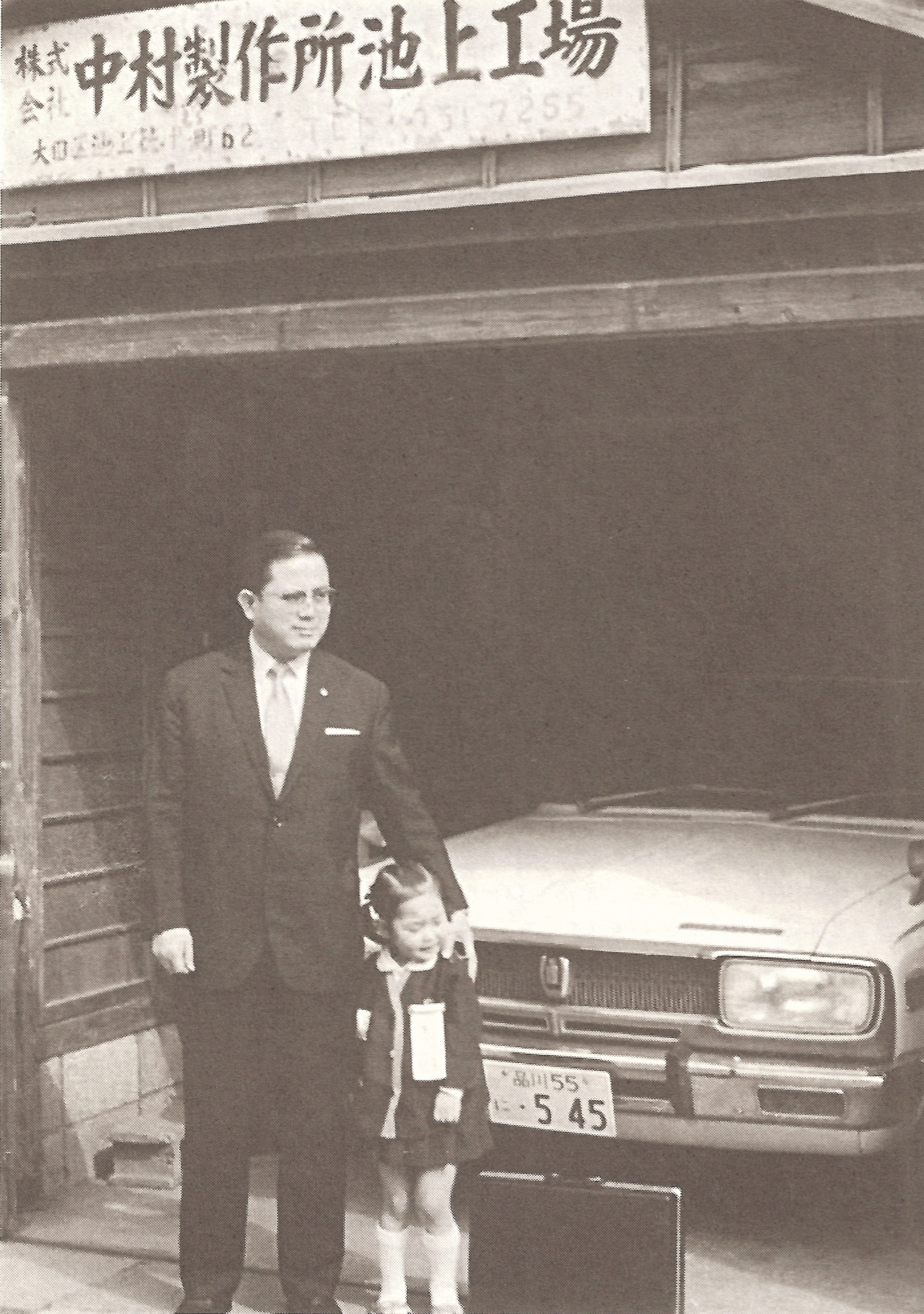
On June 1, 1955, Masaya Nakamura founded Nakamura Seisakusho (有限会社中村製作所, translated as “Nakamura Manufacturing Co., Ltd”) in Ikegami, Ota Ward, Tokyo. With a capital of 300,000 yen, the business sought to operate and supply rooftop amusement parks. There were two employees at first; Nakamura’s brother-in-law and a female office worker. Their Ikegami office was a six tatami mat-sized room, rented in the home of Nakamura’s in-laws. They couldn’t have started at a better time as rooftop amusement parks resurged in popularity post-war. But with limited capital, the products they offered at first were simple attractions made from cheap materials.
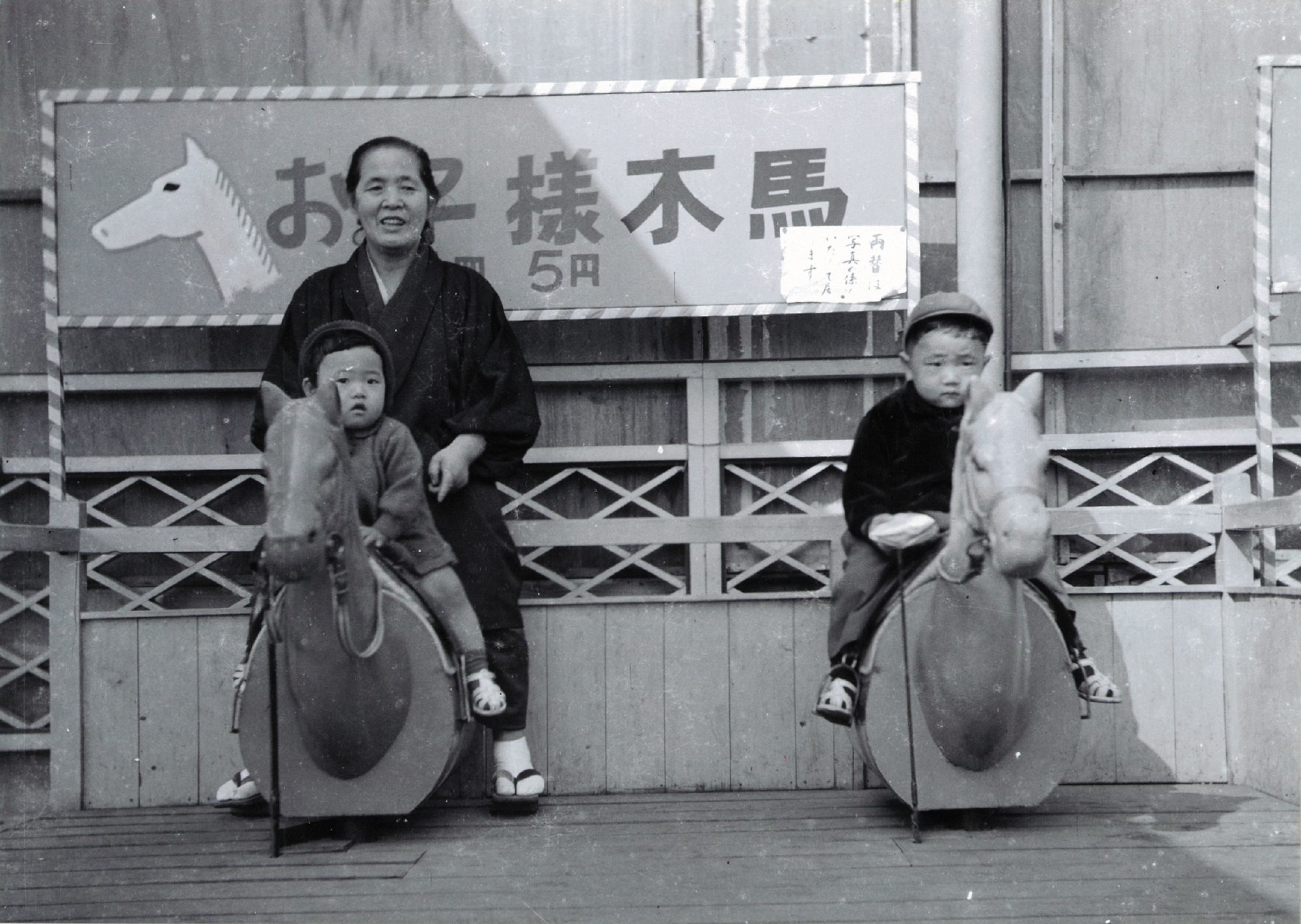
The first attractions they operated were two rocking horses that Masaya found in Ryutaro’s store shed and purchased cheaply. They had a cast metal head, an iron-plated body, a brown leather saddle, and legs that went up and down with a crank mechanism. Masaya refurbished these horses by giving them a new paint job and installing a yen slot for coin operation. Masaya couldn’t have opened up his first rooftop amusement park without these horses. Despite the fact that some stores in his area already had parks, he had an ace up his sleeve: a mutual contact at Matsuya from when he worked with his father. The contact introduced him to the manager of a Matsuya store in Isezakicho, Yokohama. After speaking to them, Masaya was granted permission to install the rocking horses on the corner of the rooftop.
With these two horses, Nakamura finally rode into the rooftop amusement park business he wished to be part of. Every day, he maintained the horses by wiping them down and oiling the mechanics. While the children of Yokohama did enjoy them, he realized some kids would only ride the machines once. If they were accompanied by parents, Nakamura would encourage the kids to have fun by saying things like “what a lively young man”, or “what a cute young lady.” This incentivized their parents to spend another coin just to see their children happy again. It’s here that Nakamura started to grasp the art of selling experiences folks could enjoy. In the years to come, rocking horses became a key product of Nakamura Seisakusho to the point they were showcased in the company’s first logo.
The next two attractions for the Yokohama park were goldfish scooping and telescopes. Catching goldfish was a popular festival activity and Nakamura felt that it would make his new park more appealing. He rode trains with a bucket in hand to the outskirts of Yokohama just to secure goldfish. A small pool (roughly 25 cm deep) was prepared and visitors used handmade scopes made from washi paper attached to wire. This activity proved difficult to manage as the goldfish would either die from motion sickness during travel or from the sun overheating the pool. For the telescopes, the company secured surplus units used by the army for a low price. After installing a timer and a shutter, the telescopes were set up at the edge of the Matsuya Isezakicho rooftop where visitors could view the city for about a minute and a half. Overall, the telescopes had far fewer hassles than the rocking horses and goldfish.
Nakamura Seisakusho’s expansion into new locations included its first partnership with a small coin-op company. Sometime after the Yokohama park opened, Nakamura heard about a machine making the rounds in the Kansai area. This device was a metal box with binoculars attached, and eight color illustrations would automatically slide alongside a recorded narration. It was the Stereo Talkie, originally commissioned by the Hankyu department store company as a tool to help folks navigate their shopping centers. The inventor of this machine was Kenzou Furukawa, who founded the company Kansai Seiki Seisakusho (commonly abbreviated as Kasco) in 1955 to produce electro-mechanical amusement machines. Soon after its release, Kasco modified Stereo Talkies to offer viewable children’s stories. In 1956, Nakamura purchased five machines (which featured stories like Snow White and the Three Little Pigs) and secured their installation at the Saikaya Department Store in Kawasaki – not too far from Matsuya Isezakicho. This became Nakamura’s second store location. When managers from different Saikaya stores observed this machine for the first time, they requested Nakamura to install units in their locations. Just like the rocking horses, the Stereo Talkies became a core product.
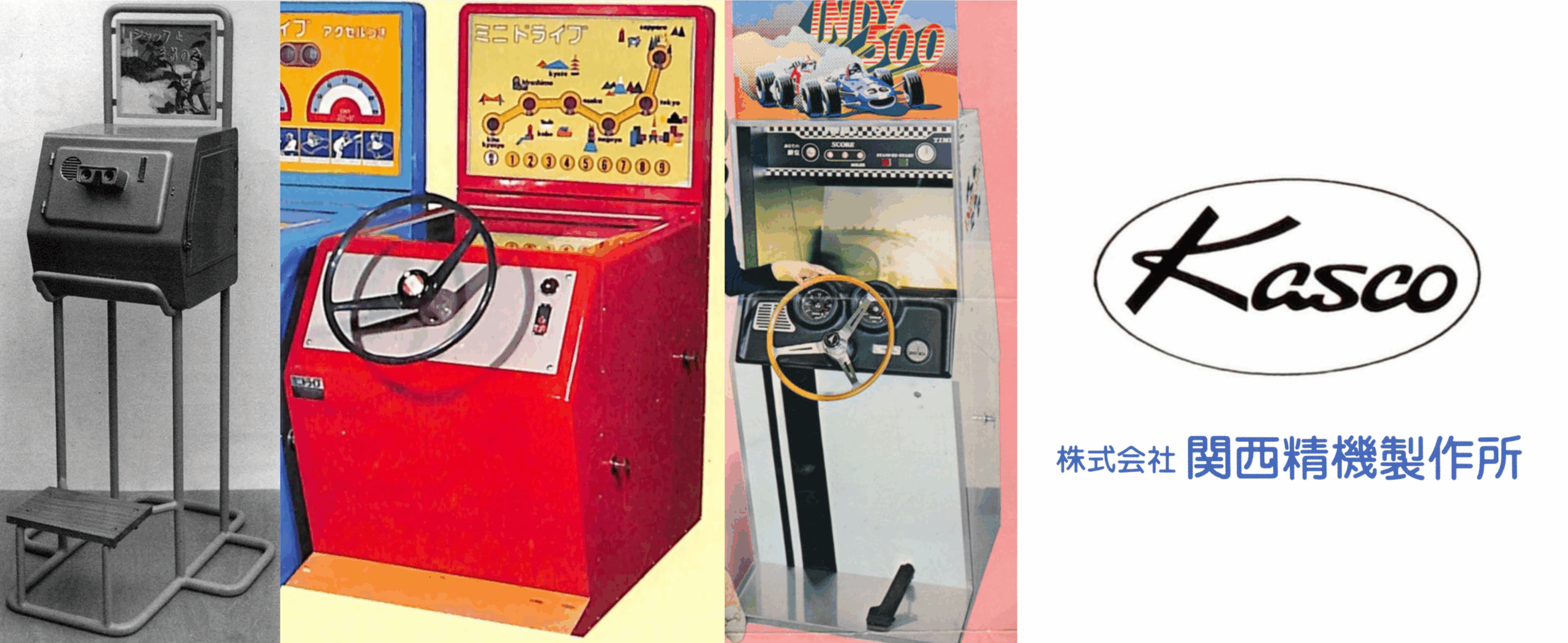
The relationship between Nakamura Seisakusho and Kasco blossomed over the years, with the former handling many of Kasco’s products in-house. In 1958, Kasco produced the successful EM game Mini Drive. Not only did Nakamura Seisakusho purchase units – they later manufactured them under their name. Former employees of Kasco recalled Nakamura visiting their main office at least once or twice on a monthly basis. This relationship enabled Nakamura’s company to expand into new locations previously unrealized, and allowed them a preview of the advanced, electro-mechanical future of the amusement industry.
Things changed rapidly for Nakamura Seisakusho by the end of the 1950s. They moved their headquarters twice (from Ikegami to two different locations in Ginza). They also started operating rooftop amusement parks in cities like Hakodate, Chiba, Aomori, and Sapporo. Finally, in 1959 they organized into a joint-stock company (株式会社中村製作所, translated as “Nakamura Manufacturing Co., Ltd”). But Nakamura was fixated particularly on two specific goals:
- He wanted to create a monorail ride. They were staples of rooftop amusement parks, and he wanted to expand his business by offering them.
- He wanted to build a rooftop amusement park for Mitsukoshi, the largest department store company of the era; their premiere location was the Nihonbashi store in Chuo, Tokyo.
Nakamura tackled the second goal first by visiting the Nihonbashi store with his proposition. At the time, Mitsukoshi had a policy to not construct rooftop amusement parks for their locations. Upon spotting the company’s president on patrol, Nakamura passionately spoke to him for an extended period of time. Nakamura prioritized his track record, his desire to work with Mitsukoshi, and even appealed to the boss for the sake of children. The president wouldn’t budge on the idea.
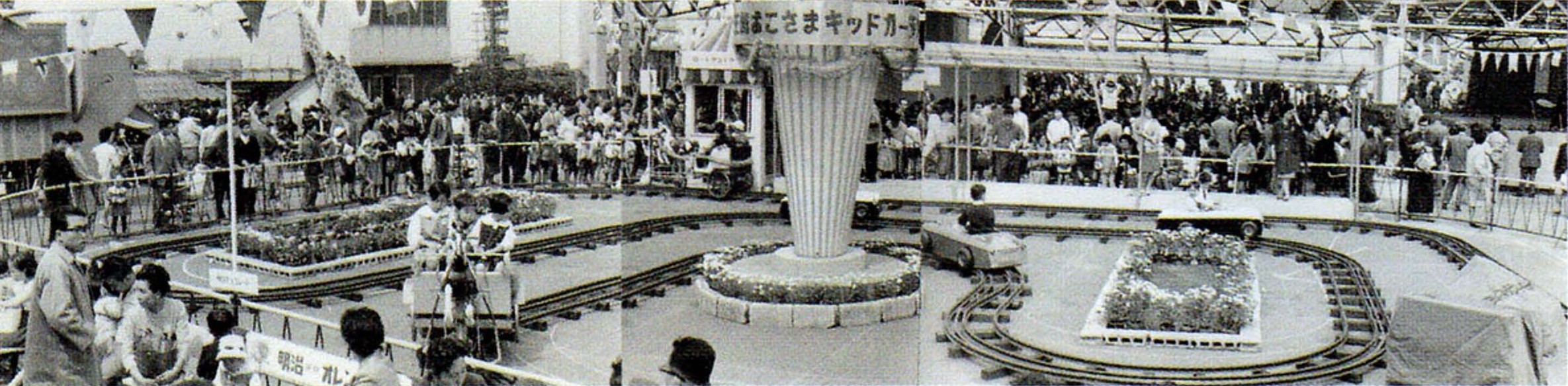
Then said president passed away, and Mitsukoshi reached out to Nakamura to do the project. Nakamura then merged his two goals, targeting his monorail ride for the Mitsukoshi store. His dream came true in April 1963, as the monorail Roadway Ride made its debut alongside Mitsukoshi Nihonbashi’s new rooftop amusement park. The company used this success to create new parks for Mitsukoshi stores in Kobe, Sendai, and Matsuyama.
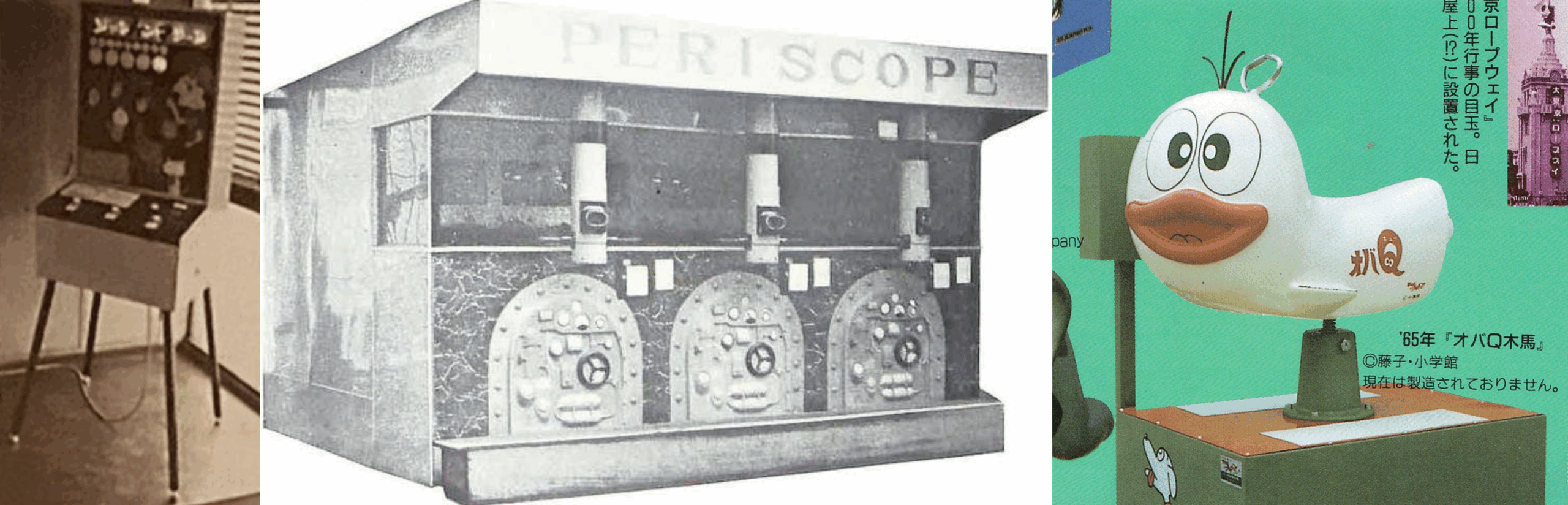
After the success of Roadway Ride, in 1965 Nakamura Seisakusho established a manufacturing department to develop electromechanical games in-house. Their first game was themed after “Rock Paper Scissors” where players selected their hand shape to try to beat the machine. Following this was Torpedo Launcher (aka Periscope) where players shot down moving warships while viewing the action through a submarine periscope. They also developed kiddie rides, some of which were themed after the popular manga Obake no Q-Taro. These rides are particularly noteworthy for being some of the earliest amusement machines where a coin-op manufacturer actually obtained a license, rather than simply skirting legal lines as was common in the United States. As EM machines became a greater focus, the company moved its head office from Ginza to Tamagawa, Ota Ward, Tokyo in 1966 where they established a dedicated factory to develop these machines.
In 1970, a group of new hires brought their keen attention to art and mechanics to the company. Engineers and artists like Kazunori Sawano and Tadashi Yamashita elevated Nakamura Seisakusho’s EM games to a new standard; they helped the company gain international notoriety once their projects went global. Examples of popular games produced in the 70s include 30 Test (1970), Formula-X (1973), F-1 (1976), Shoot Away (1977) and Submarine (1978).
Amongst these new hires was an artist named Toshio Kai, whose knowledge of music, books, and design greatly influenced Nakamura and the company. In the early 70s, Nakamura Seisakusho quietly started using the name “Namco” (short for Nakamura Amusement Machine Company); the name was used as a label on their machines and advertisements. The company strived to have their products distributed internationally and believed that Namco was an easier name to digest than Nakamura Seisakusho. Kai designed a brand new logo taking inspiration from the font seen on the 1960 album Third Stream Music by Modern Jazz Quartet. Nakamura personally chose the color red for the logo because he appreciated the packaging of Bravas cosmetics products. This sleek logo made its debut in 1972 with the EM game Crazy Buggy and was later found on games like Formula-X and F-1.
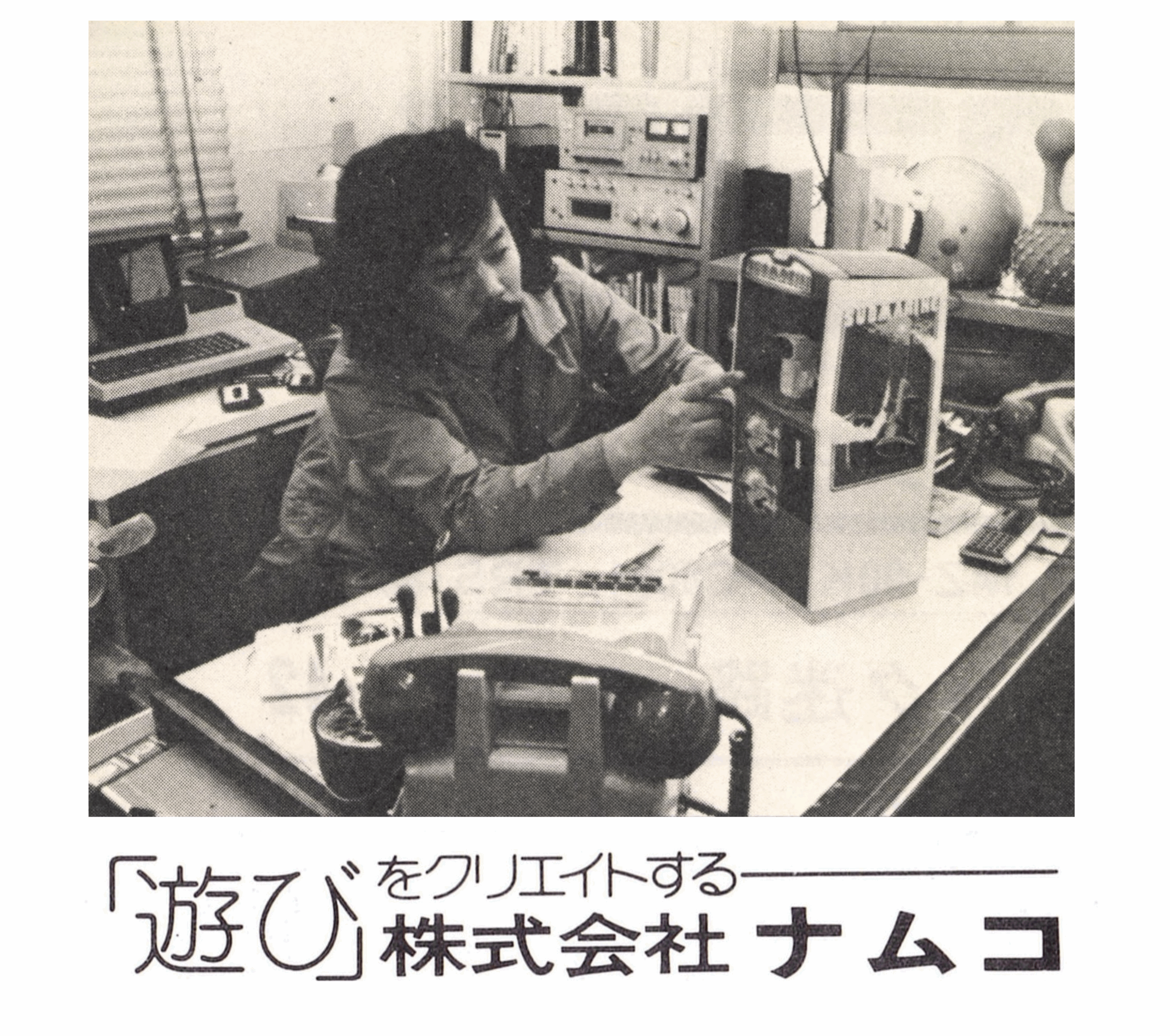
Another one of Kai’s contributions was the slogan「遊び」をクリエイトする (Creating “Play”) – it was originally printed on his business cards. “Play” was derived from two books that he later introduced to Nakamura; Johan Huizinga’s Homo Ludens (1938) and Roger Caillois’ Man, Play and Games (1961). The fundamental idea behind these books is that play is a cultural activity and that it can be classified into different elements (such as playing for competition, for chance, or role-playing). Upon reading these books, Nakamura resonated with the idea of “play”, believing it was valued by younger Japanese folks and could assist Namco in the conceptualization of new amusement machines. As Nakamura understood, “play” historically carried a negative connotation to older generations in Japan. But as younger people in the 1970s began to define trends and pursue leisure activities, having a business that was “Creating Play” sounded appealing and would fit right in with the times.
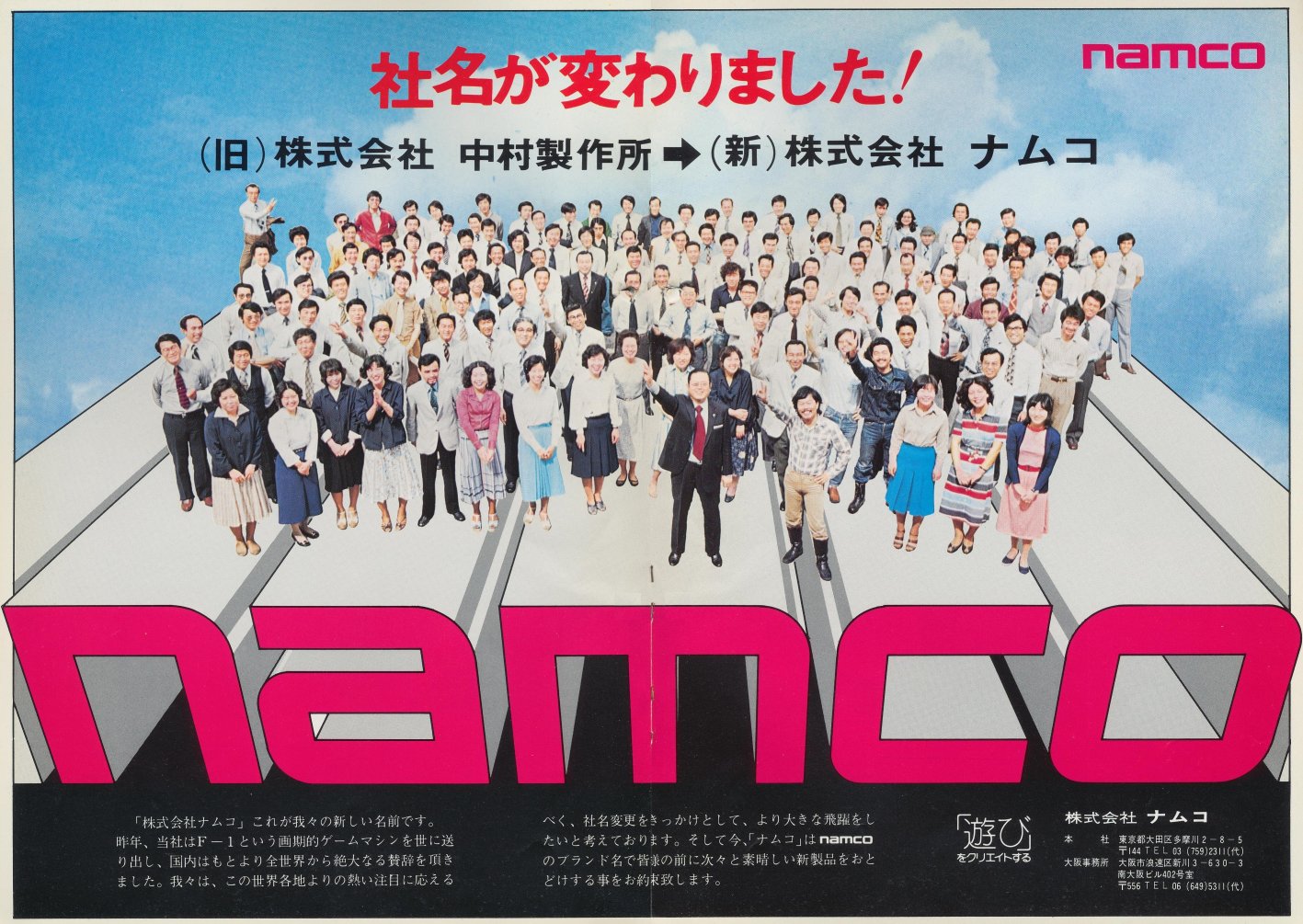
Taking into account Japan’s contemporary youth, and the prospect of reaching global audiences with new products, in 1977 Nakamura Seisakusho officially renamed itself to Namco Limited (株式会社ナムコ). They fully adopted Kai’s logo and slogan – the latter of which was printed alongside the logo on Japanese products and advertisements. In a little over twenty years, Masaya Nakamura’s business went from department store rooftops to selling coin-operated games internationally, and this rocking horse wasn’t going to stop anytime soon. This was especially true after the company was exposed to a new type of amusement machine in the mid-70s: the video game.
Namco began distributing video games created by Atari – the American developers of Pong – in 1973. This was the result of a failed effort by Atari to distribute games within Japan themselves, and their Japanese branch was sold to Namco in August 1974. Due to their maintenance work on Atari’s game boards, Namco obtained the knowledge to reverse engineer Atari’s sprite-based hardware and improved on it. Leading this effort was Shigeichi Ishimura – later President of Namco after Masaya’s retirement in 2005 – who partnered with new designer Toru Iwatani to create Namco’s first in-house video game. After receiving approval from Nakamura, the two developed Gee Bee (1978) – thus this new form of “play” changed the company forever.
Thanks:
Ethan Johnson (Play History) for giving me the opportunity to tell this story, and for his spectacular editing work.
Joey Wawzonek (The Stacks) for their tireless efforts preserving rare and out of print material.
Caitlyn Pascal (A Foreigner’s Guide to Eeremeka Arcades) for her incredibly handy database that documents Japanese electromechanical games.
Tweakbod for their time and dedication producing highly accurate Japanese transcripts.
Dexdigi, Video Game King, Ladios, and RageBeat_06 in Gaming Alexandria’s Discord for translation assistance.
If you would like to submit an article for the Origin of Game series, contact editor Ethan on the Gaming Alexandria Discord. Thanks for reading!
Sources
Akagi, Masumi [赤木真澄]. In the Beginning, There Was Pong – The Orgins of Arcade Video Games [それは「ポン」から始まった-アーケードTVゲームの成り立ち]. Amusement Press, Inc [アミューズメント通信社], September 21, 2005.
“Clockwork Heart Beauty (Series 10): Kaichi Endo and the History of Japan’s Amusement Machine Industry” [時計じかけのハート美人連載⑩ 遠藤嘉一と日本の娯楽機産業の歩み]. Game Machine [ゲームマシン], No. 212, May 15, 1983, pg. 12. Amusement Press, Inc [アミューズメント通信社].
中藤 保則. “Cultural History of Amusement Parks Part 2: Pioneers of the Amusement Industry” [遊園地の文化史 第二部、アミューズメント産業の先駆者達]. Monthly Coin Journal [月刊コインジャーナル], Vol. 7, No. 80, December 1982, pg. 93-106. Coin Journal, Co. Ltd [株式会社コインジャーナル].
“The Age of Kasco Games〜Interview with former Kansai Seiki Seisakusho Staff〜” [キャスコゲームの時代〜元・関西精機製作所スタッフインタビュー〜]. Classic VideoGame Station Odyssey [クラシックビデオゲームステーション オデッセイ], January 2003, https://www.ne.jp/asahi/cvs/odyssey/hyperlink/setframe_creators_kasco1.html. English translation by Shmuplations, https://shmuplations.com/kasco/.
“K. Endo Celebrated As AM Business Pioneer”. Game Machine [ゲームマシン], No. 335, July 1, 1988, pg. 22. Amusement Press, Inc. [アミューズメント通信社].
Maeno, Kazuhisa [前野 和久]. Research on the Ultra Creative Group Namco: A Company Ahead of the Times in the New Media Era [超発想集団・ナムコ・ニューメディア時代先取り企業の研究]. PHP Institute [PHP研究所], July 6, 1984.
Onitama [おにたま]. Mini Drive Encyclopedia [ミニドライブ大百科]. Onion Software [オニオンソフトウェア], August 12, 2023.
Smith, Alexander. They Create Worlds: The Story of the People and Companies That Shaped the Video Game Industry, Vol. 1: 1971-1982. CRC Press, November 19, 2019.
Zekuu [ぜくう]. “Namco Biography: Masaya Nakamura and the Namco Era” [Namco一代記中村雅哉とナムコの時代]. Game Lab New Year’s Holiday 2021 [ゲームラボ 年末年始2021], December 22, 2020, pg. 10-25. Sansai Books Co. Ltd [株式会社三才ブックス].
Zekuu [ぜくう]. Who Illustrated Pac-Man? Tadashi Yamashita [誰がパックマンを描いたのか 山下正 伝]. Game Dream Area 51 [ゲー夢エリア51], August 12, 2023.