
Title – ザ・ダイヤモンド (The Diamond)
System – Fujitsu FM-7
Author – 杉本 茂雄 (Shigeo Sugimoto)
Publication – LOGiN – August 1986
Preserved By – Dustin Hubbard (Hubz)
Recommended Emulator – fm7/fm77 (From Takeda Toshiya Common Source project with Included BIOS) or XM7

Loading the Game –
– Run your Fujitsu FM-7 emulator
– Insert the tape file.
– Type LOADM”DIAMOND” and hit enter
– Type EXEC and hit enter
Game Instructions –
Description & Instructions
Basically Chinese Checkers for the Fujitsu FM-7 though according to the article about the game the computer AI is rather vicious and difficult to beat. You can read a machine translation of the article below to get more details
Controls –
| * | Press while the light-blue square frame is over a piece to enter move mode. |
| SPACE | Press after moving a piece to set it in its new position. |
| HOME | Press if you’ve selected the wrong piece to move to return to the selection state. |
| Numpad 7 | Moves to the NW |
| Numpad 4 | Moves to the W |
| Numpad 1 | Moves to the SW |
| Numpad 9 | Moves to the NE |
| Numpad 6 | Moves to the E |
| Numpad 3 | Moves to the SE |
Login Article Translation –
(English Translation provided by Google Gemini and may not be fully accurate just FYI)
Entry No. 23 | FM-7 Series
3rd PRIZE
Frustrating, but let’s play again
The Diamond
A feeling of nostalgia comes with this simulation version of the board game “Diamond Game,” which features an infuriatingly strong computer opponent! For 1 to 3 players, select your opponent (computer or human) and start the game. Continuously hop over the pieces to fly across the board!
So much for my old skills… I was completely defeated by the computer! The computer is insanely strong!
The interesting thing about strategy games is that, unlike dice games where victory is determined almost entirely by “luck,” the player’s skill can decide the outcome. In short, once you learn the rules of games like Shogi, Go, Mahjong, Chess, or Othello, the rest comes down to your own ability. If you’re strong, you’ll play like a strong player; if you’re not, you won’t.
Sure, it may not be new or flashy, but I think its depth is a world only those who have played it can truly know. Shooting games where you blast away, or RPGs where you train hard to develop your hero, are of course fun. But isn’t it also nice to sometimes sit down, take your time, and wrack your brain with a strategy game?
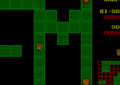
“The Diamond,” which brilliantly won 3rd Prize this month, is a piece of work that lets you re-appreciate the fun of such strategy games. Looking at the game screen in the upper right, I’m sure there are readers who have played this (or at least recognize it). That’s right, it’s a simulation of that nostalgic board game, “Diamond Game.” I used to play it a-l-o-t, too.
Since it’s a generally widespread game, I thought about skipping the explanation, but for those who don’t know, I’ll leave the detailed instructions for the next page… Simply put, it’s a game where the objective is to be the first to move your own 15 pieces, located in a hexagonal area of the board, to the identically colored area on the opposite side.
Frankly, I’ve lost my confidence. It’s so stroooong!
Why would anyone decide to make such a nostalgic game now? It has absolutely no originality and no new features whatsoever. However, it’s strong. Insanely strooong! It’s so frustratingly strong. The rules are simple, so I thought, “I might win by a fluke,” but you can’t. Personally, I was confident in my skills at this game, but… In any case, it’s a very challenging piece of work. (Muroya)
You move by hopping over your opponent’s pieces one by one. Are you starting to remember now? The game can be played by 1 to 3 players, and you can choose to play against the computer or other humans.
Well then, let’s start the game right away. A few minutes after starting, I was soundly defeated by the computer. The computer opponent is incredibly strong, and my old skills were completely useless. So far, in every match I’ve challenged against the computer (where the other two players are computer-controlled), I have never once been the first to move all my pieces. The best I can do is 2nd place.
“Damn it! What the hell! I’ve been playing this game since I was a kid. There’s no way I’m losing to some computer!” is how fired up this game makes you. The computer’s thinking routine (algorithm) determines its move in at most 2 seconds, moving its piece in an instant. Because of this, when you’re playing against the computer, you’ll think your turn is over, and in the blink of an eye, it’s your turn again. And what’s more, it always moves its piece to an annoying spot.
I heard from the creator that “the computer searches up to 125 patterns to decide which piece to move and where to move it,” so I understood that its strength is guaranteed, but losing is still infuriating!
Well then, shall I introduce the detailed game rules on the next page? Alright!
Introducing the Rule Differences – Memorize them well!
Before we get into the game rules, for your reference, the original board game version of “Diamond Game” is based on “Chinese Checkers,” which came from China. Just hearing “China” makes you dream of a vast continent, doesn’t it?
Anyway, let’s put aside the long history of China for now and get to explaining the game rules. This game has slightly different rules from the board game version, so let’s introduce those differences first.
【Board Game Version】
① The king piece can jump over any number of pawn pieces in a single line. ※Pawns are any piece other than the king.
② You cannot move into another player’s home base, but you can cross the boundary line.
③ Pawns cannot jump over the king piece.
【The Diamond Version】
① Both kings and pawns must jump over pieces one at a time. Pawns can also jump over kings.
② You can move into another player’s home base. You can also stop on the boundary line.
The major differences are as listed above, so be careful when you play. I think the game has become more interesting due to having fewer restrictions than the board game version.
Next, the game rules are on the right, so let’s look at them along with the key controls. The computer’s strength is no joke!
Here are the game rules!
First, enter the number of players. 1 to 3 players are possible.
1 Player: The computer controls the other 2 players.
2 Players: The computer controls the other 1 player.
* After entering the number of players, the game starts with the SPACE key.
* On your turn, move the light-blue square frame onto the piece you want to move.
* Next, press * key, and the frame will turn purple, allowing you to move the piece with the ten-key pad. ※ At this time, if you press HOME, the piece will return to its original position.
* Once you’ve moved the piece, press SPACE to set it in that location, and the turn passes to the next player.
* Pieces move one intersection at a time, but if there is a piece to jump over in an adjacent spot, you can jump over it.
* In other words, if there is a piece every other space (regardless of color), you can jump over them continuously. ※You cannot jump if two or more pieces are lined up next to each other.
* You cannot stop in another color’s area, but you can stop on the boundary line. Of course, passing through is OK.
* The person who places the king piece with the ☆ mark at the very end (the ● position) and has moved all 15 of their pieces wins. The game ends when the last person has finished moving. To quit the game mid-way, press ESC.
(Section: Key Controls)
| Key | Function |
| * | Press while the light-blue square frame is over a piece to enter move mode. |
| SPACE | Press after moving a piece to set it in its new position. |
| HOME | Press if you’ve selected the wrong piece to move to return to the selection state. |
| Numpad 7 | Moves to the NW |
| Numpad 4 | Moves to the W |
| Numpad 1 | Moves to the SW |
| Numpad 9 | Moves to the NE |
| Numpad 6 | Moves to the E |
| Numpad 3 | Moves to the SE |
Human vs. Human
◆ Now, a human-on-human battle. Have fun playing intensely with your friends while trash-talking!
◆ When playing against the computer, play for your life. Otherwise, you’ll get crushed. No mercy!
To Beat the Computer, Mark the Yellow Pieces!
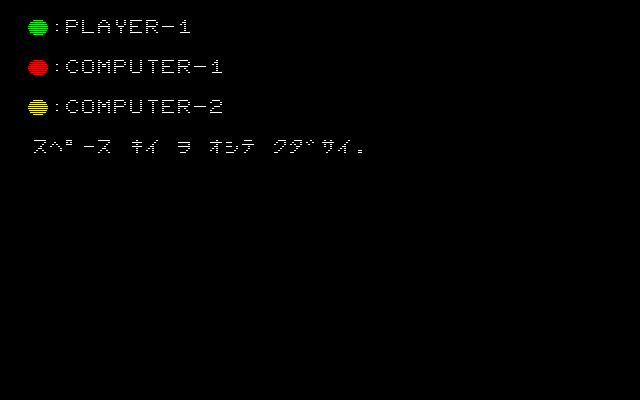
This might not be helpful, but here’s a little tip for victory. If you’re playing against two computer opponents, the one to mark is “COMPUTER-2” (hereafter, Yellow), which moves the yellow pieces. Yellow teams up with “COMPUTER-1” (hereafter, Red), which moves the red pieces, to challenge you. If you don’t take some kind of countermeasure, Yellow will always be the first to finish.
The movement of the Yellow and Red pieces in the opening is almost identical, so it’s important to first study their movement patterns. Since the match has just begun, secure a movement path for your own pieces during this time.
In the mid-game, it’s time to start marking Yellow. Red will try to block your path, intentionally leaving pieces in annoying spots even when it could make consecutive jumps. During this time, Yellow is creating its own unique movement path. If you want to be blunt, it’s dirty, but Yellow creates its own path as if to say, “a win is a win.”
In short, the key to victory lies in blocking this unique movement path of Yellow’s. The computer has about 8 opening patterns, so-called “joseki” (standard openings). If you can seal off those openings, you might be able to win surprisingly easily. Still, getting 1st place might be difficult.
You who aim to be a star game designer, submit to the Software Contest right now!
Prize Money: ¥300,000 + Packaged for Sale
The “Login Software Contest” accepts three original programs as entries each month. Committees are held for the first half and second half of the year to judge the 18 entry programs from each period. The results are announced in the January and July issues of the magazine. (The 2nd round of judging will be announced in the ’87 January issue).
If a particularly excellent program is entered, it will be recognized with a Grand Prize or Excellence Award (there may be times when no work is selected). The program that wins the Grand Prize, and a portion of the programs that win an Excellence Award, will be packaged and sold.
Login Software Contest: Submission Guidelines
Submission Categories:
A: Game Program Category
B: Game Scenario Category
Submission Conditions: Unpublished, original works. At the request of ASCII Corporation, entries must be limited to those that can be published in Login magazine and sold via Tape Login and as a packaged product. Winners will conclude an exclusive use license agreement with ASCII Corporation. Copying all or part of another person’s program, double submissions, etc., are strictly prohibited.
How to Apply: Please be sure to enclose the following documents with your submission.
The media on which the program is recorded.
Instructions on loading method, execution method, how to play, etc.
Your address, full name, age, phone number (where you can be reached), and the bank account for prize money/royalty transfers (Bank name, Branch name, Account number, Account holder’s name, Account holder’s address).
Note: Applicants under 20 years of age must receive permission from a guardian and also provide the guardian’s address, full name, and phone number.
Prize Money: Prize money will be awarded to those whose works are selected as entries.
Grand Prize: ¥300,000
2nd Prize: ¥200,000
3rd Prize: ¥100,000 (Note: The game on this page received ¥100,000)
In addition, royalties for the monthly Tape Login will be paid for all award-winning works. A portion of the contest’s Grand Prize and Excellence Award winners (decided in Jan/July) will be subject to being packaged for sale. In that case, package royalties (per our company’s regulations) will be paid.
Mailing Address:
〒107 Tokyo-to, Minato-ku, Minami-Aoyama 6-11-1, Three F Minami-Aoyama Bldg.
ASCII Corporation, Login Editorial Department
“Login Software Contest” Desk
Ported Versions Also Wanted!
This corner is also widely seeking ported versions of software previously published in Login magazine for other computer models. If you have created a ported version, please send it to the address above.